The Victoria Art Gallery Bath Detail of Smugglers Landing by Jaques De Loutherbourg
The Victoria Art Gallery is the public art museum in Bath. It is run by Bath & Northward East Somerset Quango and houses its collection of paintings, sculpture and decorative arts.
The collection includes many works by artists who have lived and worked in the expanse, such as Thomas Gainsborough and Walter Sickert. In the 18th century Bath was an important centre for portrait painting, in the 20th century it again became famous with the innovative works produced by artists working at Bath University of Fine art.
The Upper Gallery houses a permanent brandish of the best works from the collection. The Gallery is currently closed to the public, but all of the works on our walls tin can exist viewed here in this virtual display.
Artists featured in this Curation: Hugo van der Goes (c.1440–1482), Hans Holbein the younger (c.1497–1543), Titian (c.1488–1576), Louis de Caullery (before 1582–later 1621), January Brueghel the elder (1568–1625), Peeter Neeffs the elder (c.1578–1656/1661), Adriaen de Bie (1593–1668), Izaack van Oosten (1613–1661), Matthieu van Helmont (1623–1679), David de Coninck (1636–1699), and 69 more Meet all Willem Wissing (1656–1687), Benedetto Gennari the younger (1633–1715), Isaak van Nickele, Godfried Schalcken (1643–1706), Pieter van der Werff (1665–1722), Francis Bird (1667–1731), British Schoolhouse, Charles Jervas (c.1675–1739), Samuel Scott (c.1702–1772), Prince Hoare the elder (1711–1769), Thomas Gainsborough (1727–1788), James Barry (1741–1806), Thomas Hickey (1741–1824), Johann Zoffany (1733–1810), Joseph Farington (1747–1821), Thomas Beach (1738–1806), Thomas Barker (1769–1847), Philip James de Loutherbourg (1740–1812), Antonio Canova (1757–1822), Peter Turnerelli (1774–1839), Sebastian Pether (1790–1844), James Green (1771–1834), Thomas Jones Barker (1815–1882), John Syer (1815–1885), David Cox the elder (1783–1859), William Duffield (1816–1863), John Warrington Wood (1839–1886), Calvert Richard Jones (1804–1877), John Callcott Horsley (1817–1903), John Robert Dicksee (1817–1905), George Frederic Watts (1817–1904), Frederick George Cotman (1850–1920), Emmeline Deane (1858–1944), Mihály Munkácsy (1844–1900), Thomas Sidney Cooper (1803–1902), Robert Gemmell Hutchison (1855–1936), Edwin Long (1829–1891), George James Frampton (1860–1928), Albert Bruce-Joy (1842–1924), Walter Langley (1852–1922), Henry Herbert La Thangue (1859–1929), Robert McGregor (1847–1922), Gaston Linden, John Collier (1850–1934), Walter Richard Sickert (1860–1942), William Logsdail (1859–1944), John Charlton (1849–1917), Edwin Whitney-Smith (1880–1952), Frank Brangwyn (1867–1956), Glyn Warren Philpot (1884–1937), Paul Klee (1879–1940), Joseph Edward Southall (1861–1944), John Armstrong (1893–1973), John Northcote Nash (1893–1977), Frederick George Swaish (1879–1931), Algernon Talmage (1871–1939), Matthew Arnold Bracy Smith (1879–1959), William Patrick Roberts (1895–1980), Male monarch Whistler (1905–1944), William Scott (1913–1989), Kenneth Armitage (1916–2002), William Brooker (1918–1983), Mary Fedden (1915–2012), Gillian Ayres (1930–2018), Peter Blake (b.1932), Grayson Perry (b.1960), Howard Hodgkin (1932–2017), Sophie Ryder (b.1963) and Peter Randall-Page (b.1954)
94 artworks
.
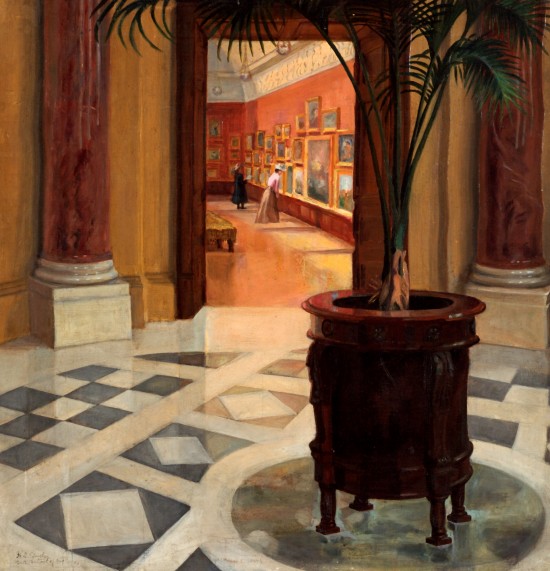
© the copyright holder.. Photograph credit: Victoria Fine art Gallery
The Interior of the Victoria Art Gallery, 1903
Hester Quinton Eversley (1877-1965)
Art earlier the Georgians
The works of art in our collection bridge seven centuries, from the late 15th century to the nowadays twenty-four hour period. This brandish shows how fine art has changed. Beliefs, attitudes, fashions and tastes take shaped the development of art. Dissimilar techniques and the availability of materials take had equal impact.
Religious paintings are amidst the oldest in our collection. In Catholic churches, paintings of biblical subjects were used to educate and inspire congregations. When services were in Latin and few people could read, art was a vital medium for Christianity.
Before the 18th century, portraiture was for the wealthiest and most influential people. Portraits could impress the viewer with the wealth and power of the sitter.
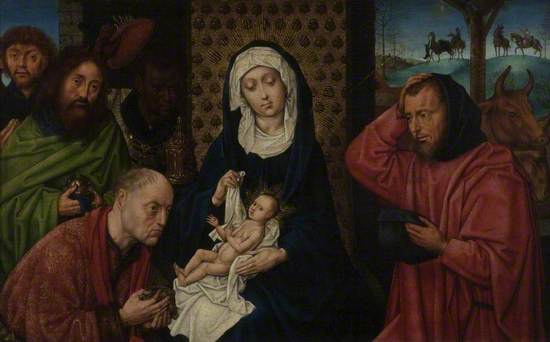
1480
Photograph credit: Victoria Fine art Gallery
Art earlier the Georgians
The subject is from St Matthew'due south Gospel and shows the Magi, or three Wise Men, offering gifts of gold, incense, and perfumed ointment to the newborn Christ child.
This is the oldest painting in the Gallery's drove and was long thought to be by the Flemish painter, Hugo van der Goes (1420-1482). He was a central figure in the Renaissance in northern Europe, which differed from the southern version in its precise attention to detail and truth to nature.
One of van der Goes' achievements was to pioneer a variant of the Magi bailiwick with one-half-length figures, thereby allowing a greater intimacy. The current thinking, however, is that the picture was painted by an unidentified follower of van der Goes.
The Adoration of the Magi
Hugo van der Goes (c.1440–1482) (circumvolve of)
Oil on board
H 43.3 x W 72.3 cm
Victoria Fine art Gallery
1540
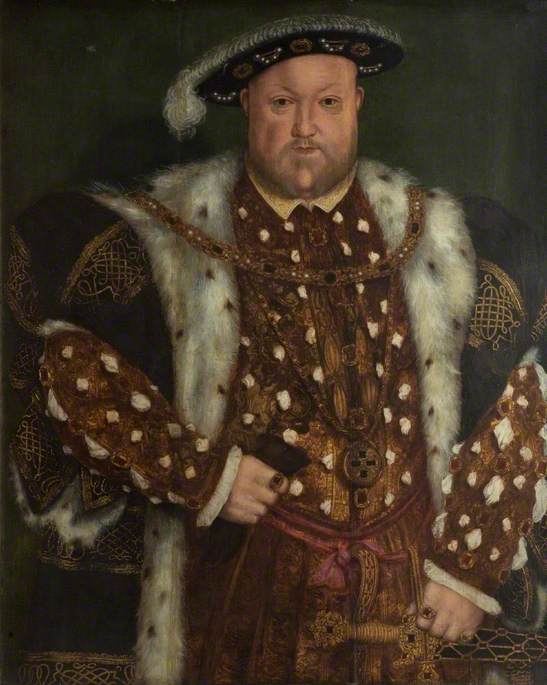
Photo credit: Victoria Art Gallery
Fine art before the Georgians
This painting was conserved in 2017 to fix two minor splits which had adult. Infrared photos were taken that showed the underdrawings and dendrochronology was used to engagement the painting, to 1527-1557.
This portrait is based on a fresco that Holbein painted in Whitehall Palace in 1537. Information technology depicted the start ii generations of the Tudor dynasty and was intended to celebrate and bolster the significance of this regal family. The palace was destroyed by fire in 1698 and the fresco with it.
In the 16th century paintings were made past copying the figures from the fresco. Henry VIII was not a patient man. He would have been unwilling to sit for portraits regularly. Imperial portraits were popular gifts to favoured courtiers or foreign diplomats.
Henry VIII (1491–1547)
Hans Holbein the younger (c.1497–1543) (afterwards)
Oil on lath
H 90.five x Westward 73 cm
Victoria Art Gallery
1550
Photograph credit: Victoria Fine art Gallery
Art before the Georgians
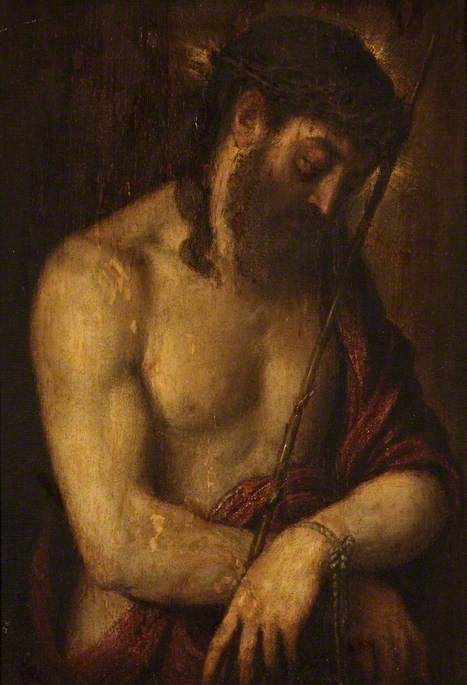
In 1547 the Venetian artist Titian painted Ecce Homo for Emperor Charles 5. It was so well received that several copies were produced by the creative person'southward studio, of which this is i.
In the Bible, the words 'Ecce Homo' (translated as 'behold the human') are used past Pontius Pilate when he presents Jesus, who has been whipped and crowned with thorns, to a hostile oversupply before the crucifixion.
Ecce Homo
Titian (c.1488–1576) (afterward)
Oil on console
H 38.half dozen ten Due west 27.6 cm
Victoria Art Gallery
1604
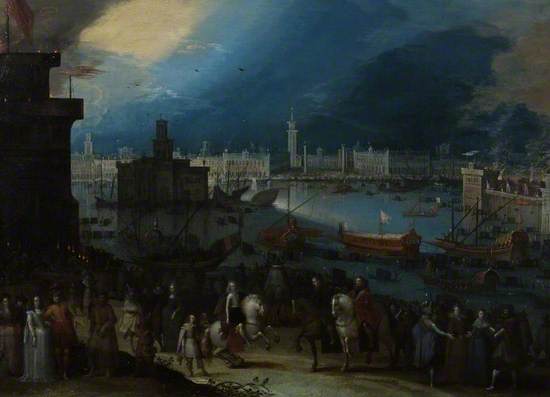
Photograph credit: Victoria Art Gallery
Art before the Georgians
This picture has been at the Gallery ever since information technology opened and has always had the aforementioned title.
The Medici were the rulers of Florence. Several of them were called Cosimo. The trouble is that the important-looking people shown hither are non wearing or carrying anything which identifies them as members of the Medici family.
This picture shows well-known landmarks such every bit the Doge's Palace and St Mark's, only it also includes imaginary buildings. Perchance the creative person enjoyed using his imagination, or perhaps he never visited Venice and instead copied other artists' engravings of the city.
.
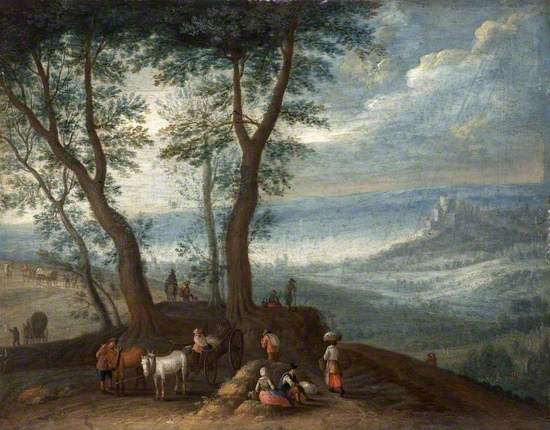
Photo credit: Victoria Art Gallery
Art before the Georgians
Mural with Travellers c.1600–c.1700
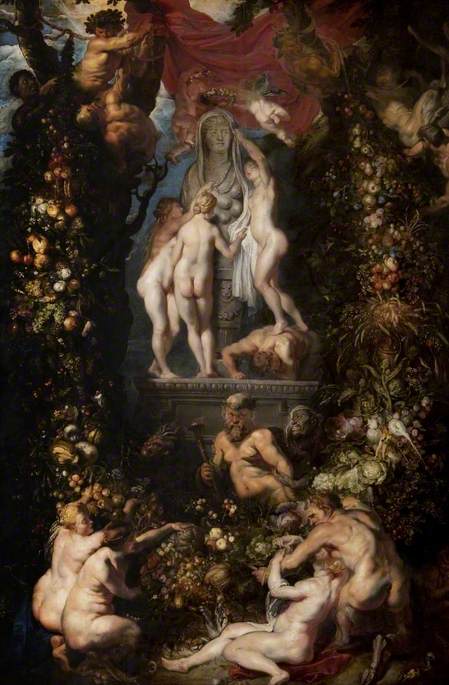
Jan Brueghel the elder (1568–1625) (circle of)
Oil on copper
H 19.3 x W 24.7 cm
Victoria Fine art Gallery
1625
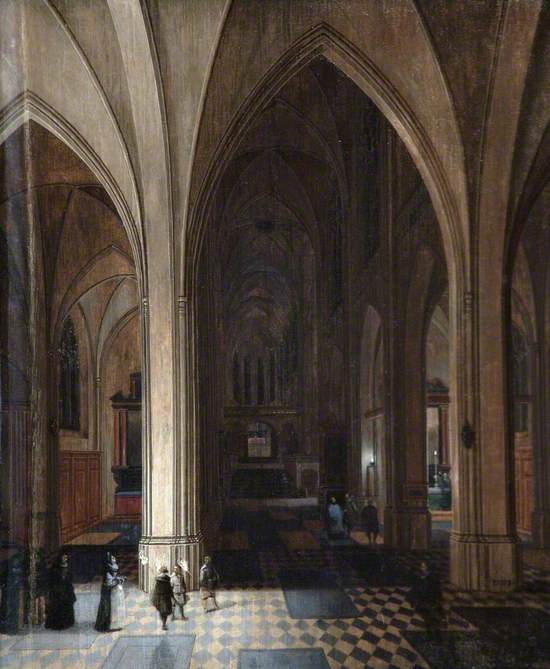
Photo credit: Victoria Art Gallery
Art before the Georgians
Peeter Neeffs was born and died in Antwerp. He was one of a number of Netherlandish painters of the 17th century who specialised in paintings of buildings, especially church interiors.
Neeffs entered the Antwerp Gild of painters in 1609 and must accept been very poor, for he was in debt to the Guild at the historic period of 35. He frequently worked in partnership with other artists, calculation architectural elements to their pictures. His son, Peeter the Younger, studied under him and imitated his style so closely that information technology can exist difficult to tell their work apart.
Vespers c.1625
Peeter Neeffs the elderberry (c.1578–1656/1661)
Oil on console
H 28.7 10 West 23.6 cm
Victoria Art Gallery
1630
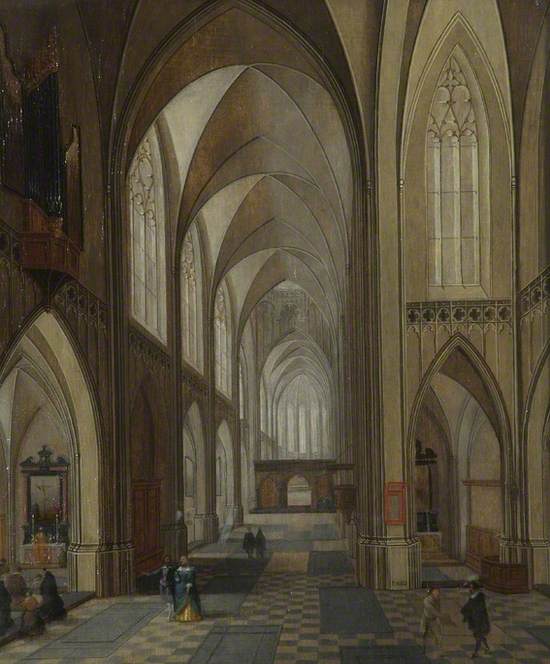
Photo credit: Victoria Art Gallery
Fine art before the Georgians
This painting and its pair, Vespers, were clearly designed to contrast the effects of daylight and artificial light. They appear to draw the same church, although the tiles are laid diagonally in one picture, and from left to right in the other. The identity of the church is not known, although the presence of bronze would be consistent with a church in Catholic Flanders. The churches in neighbouring The netherlands were stripped of their statuary following the nation's conversion to Protestantism in the 16th century.
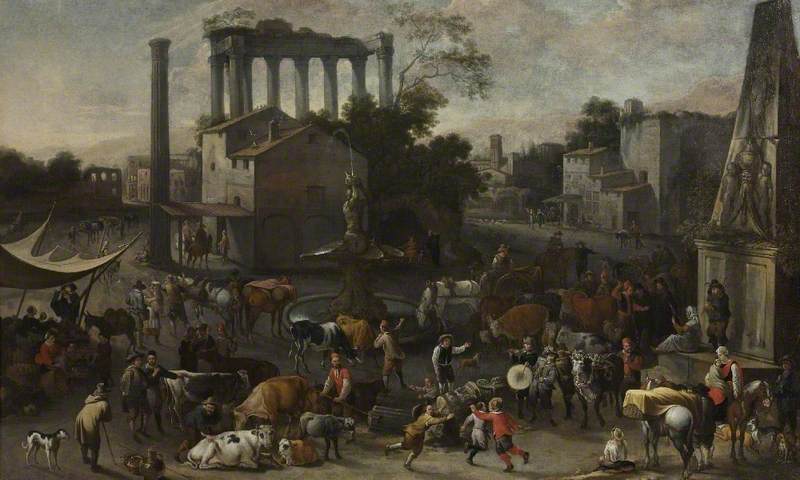
1643
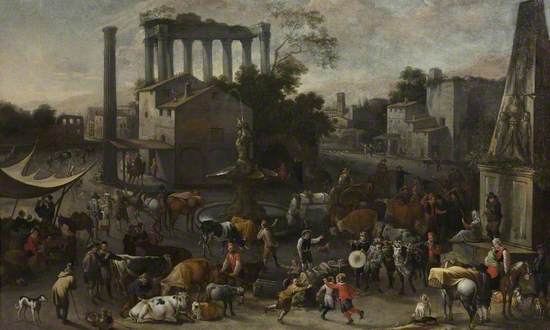
Photo credit: Victoria Art Gallery
Art before the Georgians
The festival atmosphere of a cattle market is captured in this scene, amongst the ruined monuments of aboriginal Rome. This area was the Roman Forum, but in subsequently centuries the wide infinite was perfect for the ownership and selling of cattle.
Campo Vaccino, Rome 1643
Adriaen de Bie (1593–1668)
Oil on canvas
H 122.2 ten W 202.8 cm
Victoria Art Gallery
.
Photograph credit: Victoria Art Gallery
Fine art earlier the Georgians
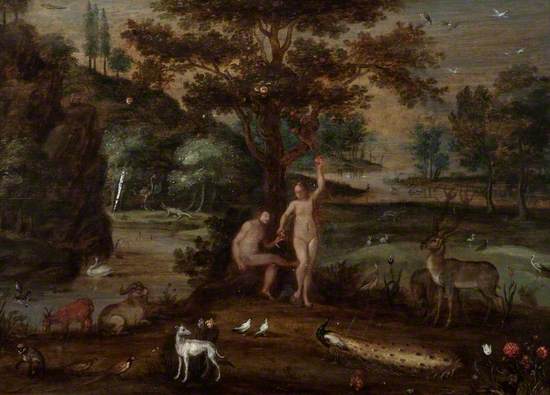
Very little is known about the Flemish painter Izaack van Oosten. He specialised in painting small landscapes with animals, somewhat in the style of his amend known contemporary, January Brueghel. Many 17th-century painters in Flanders and Holland worked to a small scale as information technology suited the intimate domestic interiors of their patrons. Pocket-sized dimensions besides made their pictures more than affordable.
.
Photograph credit: Victoria Art Gallery
Art before the Georgians
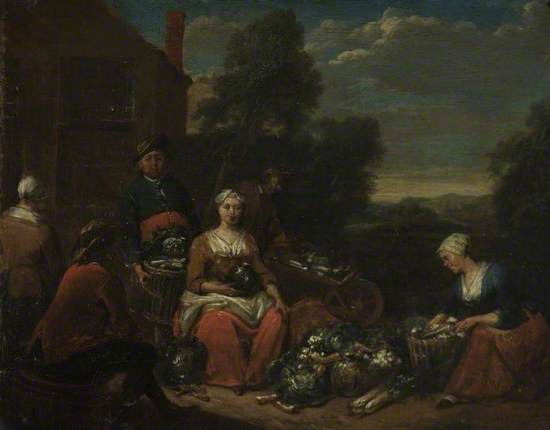
Vegetable Marketplace
Matthieu van Helmont (1623–1679)
Oil on panel
H 18 ten W 23 cm
Victoria Fine art Gallery
.
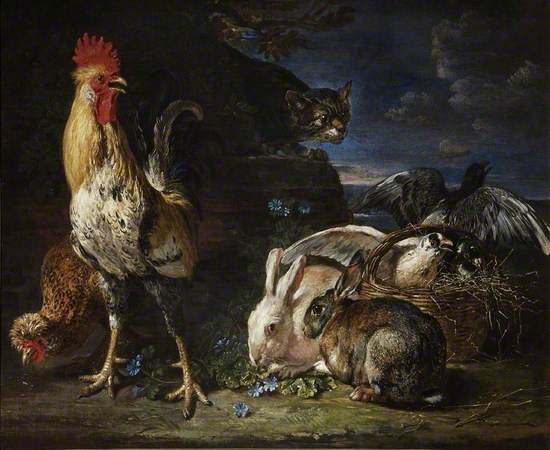
Photo credit: Victoria Art Gallery
Art before the Georgians
This painting is full of drama. The cat is preparing to pounce. The potential victims are in varying degrees of awareness; the rabbits are oblivious, the cockerel nervous and other birds are preparing for flight.
Finely painted textures and dramatic lighting raise the realism and tension.
The Antwerp-born creative person David de Coninck spent most of his working life in Rome. He was successful still life and animate being painter, rabbits being his favoured subject. Today simply about 1 tenth of his paintings are signed by him. In some cases his signature may have been deliberately erased in order to pass his paintings off as the work of other artists.
1680
Photograph credit: Victoria Art Gallery
Art before the Georgians
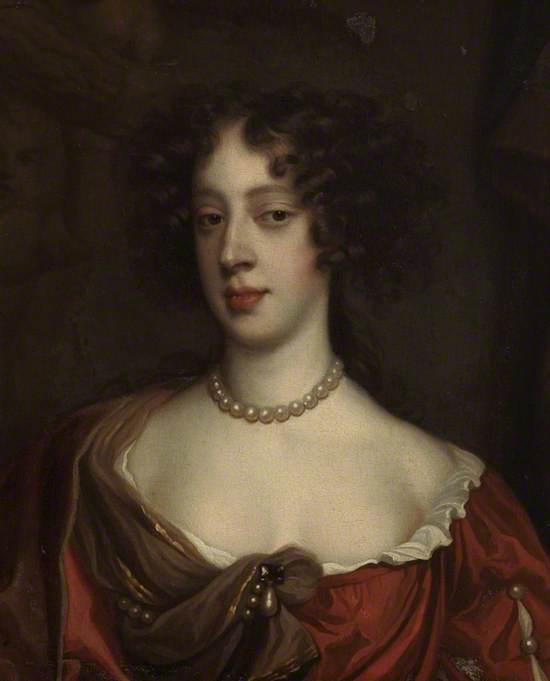
In 1687 James II brought his wife, Mary of Modena, to Bath. He hoped that bathing in the thermal waters would cure her infertility and allow her to produce an heir to the throne.
Controversially, the couple were Catholic at a fourth dimension when religion was a highly charged political consequence. Nine months afterward the visit a son was born. The Cosmic heir appalled Britain'due south Protestant establishment and was in part responsible for the 'Glorious Revolution' of 1688. James II was deposed and exiled to France, his Protestant daughter Mary took to the throne.
This painting is a reminder of Bath's role in the political intrigues of the twenty-four hour period.
Queen Mary of Modena (1658–1718)
Willem Wissing (1656–1687) (attributed to)
Oil on canvas
H 58.5 x Westward 47.5 cm
Victoria Art Gallery
1686
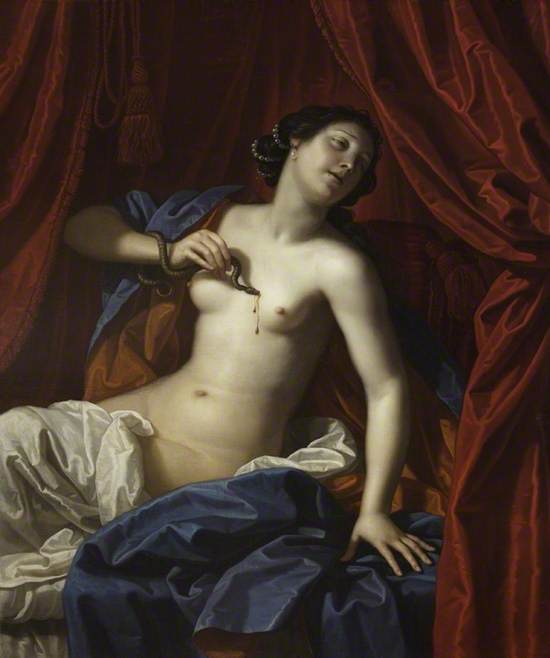
Photo credit: Victoria Art Gallery
Fine art before the Georgians
This Cleopatra looks nil similar an ancient Egyptian. People in the 17th century knew niggling about the ancient world. Instead, they would known her every bit the heroine of Shakespeare's play Antony and Cleopatra. This would have been commonly performed in the 1680s. Benedetto Gennari painted this tragic heroine more than once. This was produced for a wealthy politician, Francis Gwynne, and Gennari had painted a previous version for Charles Ii.
The Death of Cleopatra
Benedetto Gennari the younger (1633–1715)
Oil on canvas
H 129.five 10 West 101.2 cm
Victoria Fine art Gallery
1690
Photograph credit: Victoria Art Gallery
Art before the Georgians
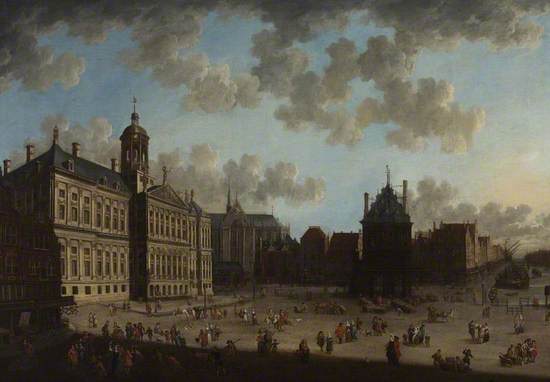
At present known as the Royal Palace, Amsterdam's boondocks hall, shown on the left of the painting, was built in the late 17th century. Its predecessor had burned downwards, and the new building, with its classical details and grand scale, was a source of smashing pride in the city. Dam Square, in front of the Stadhuis, has always been Amsterdam's hub, a place for people to meet and business concern to exist done.
The Stadhuis, Amsterdam
Isaak van Nickele (agile 1660–1703) (attributed to)
Oil on canvas
H 112.5 10 Westward 163 cm
Victoria Fine art Gallery
.
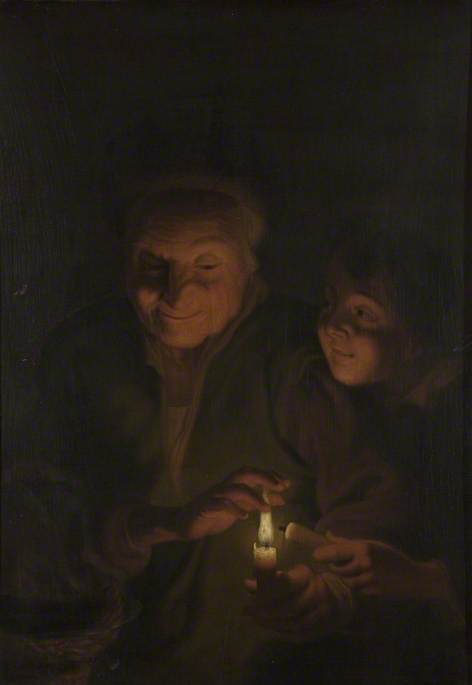
Photo credit: Victoria Art Gallery
Art before the Georgians
Onetime Adult female and Boy with Candles
Godfried Schalcken (1643–1706) (attributed to)
Oil on panel
H 43.3 x West 31.3 cm
Victoria Art Gallery
1709
Photograph credit: Victoria Art Gallery
Art earlier the Georgians
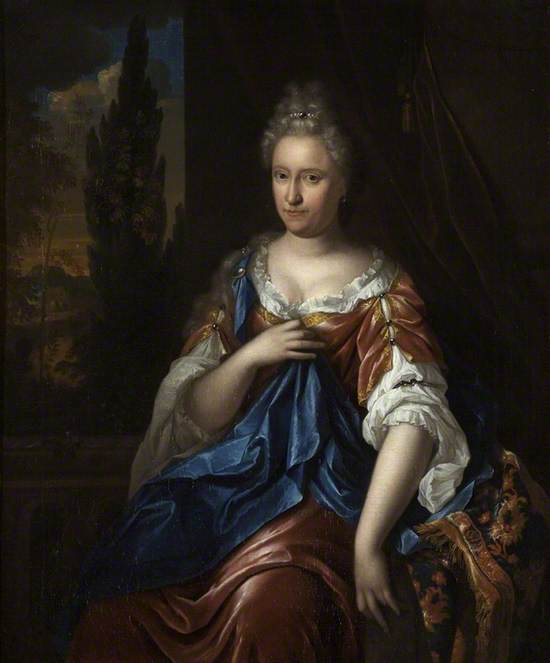
Pieter van der Werff was a Dutch painter. For many years he was in the shadow of his elder brother Adriaan. In his lifetime, Adriaan van der Werff was the nigh successful and highly paid Dutch artist, working for kings and princes. For many years, Pieter simply fabricated copies of his brother'south paintings, but in after life he established himself equally a painter in his own right.
1709
Photograph credit: Victoria Art Gallery
Art before the Georgians
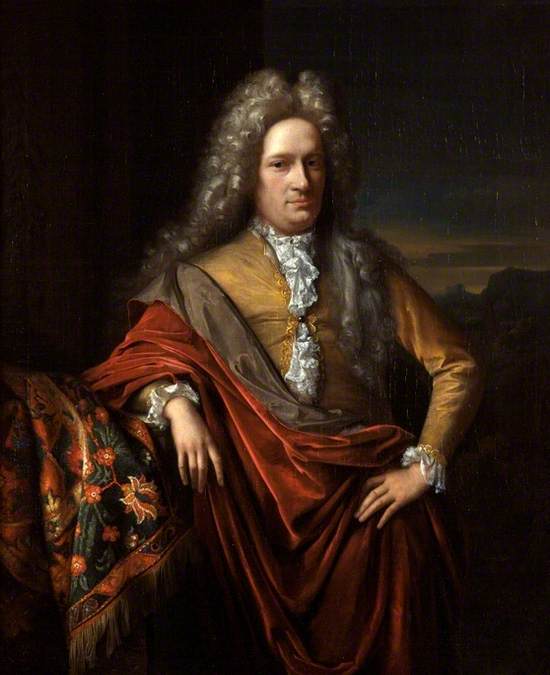
For many years information technology was believed that this portrait and the one higher up were of the Duke and Duchess of Marlborough. It at present seems that this is not the case, and unfortunately we do not know who this couple are. The sumptuous lace, silk, and velvet that they wear clearly mark them out equally very wealthy people.
Portrait of an Unknown Lady 1709
Pieter van der Werff (1665–1722)
Oil on canvas
H 46.7 x West 40.six cm
Victoria Art Gallery
Georgian and Regency Art
During the 18th century, the market for fine art grew and changed. This was a period of great prosperity. The wealthy had coin to travel abroad, where they bought pictures as mementoes of their 'Grand Tours'. Paintings were not only beautiful things, merely also a way to demonstrate wealth, noesis and good gustatory modality.
In Bathroom, sitting for a portrait became an essential activity for the tourists who came for the spa cure and recreation. Artists who could capture a likeness were almost guaranteed a skilful income. The most talented and successful artists, such equally Thomas Gainsborough, allowable great respect and were able to accuse high prices for their work.
1716
Photograph credit: Victoria Art Gallery
Georgian and Regency Art
Cloudesley Shovell joined the navy aged 14 and spent nigh of his life at sea. Despite many successes, he is remembered mainly for an incident which involved the wrecking of several ships off the Scilly Isles, and led to his own expiry.
1729
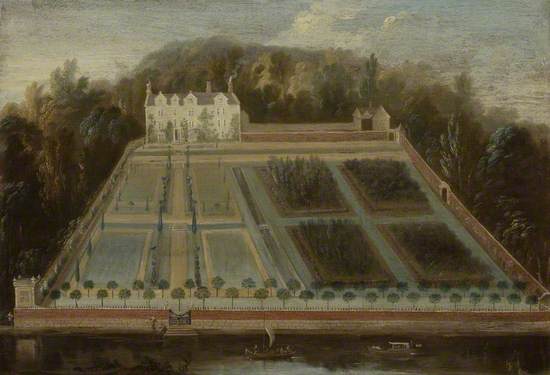
Photo credit: Victoria Art Gallery
Georgian and Regency Fine art
Images of Bathroom before the Georgian expansions are rare. This picture was painted at around the same time that John Woods was offset work on Queen Square, the showtime phase of his building program for the urban center. Buildings like Ladymead Firm were nearly to go a rarity in fashionable, modern Bath. The house in the painting dates from effectually the 1680's.
The painting was discovered in the attic of Ladymead House itself. In 1977, an architect unearthed the painting while conducting a survey of the buildings of Walcot Street. He realised that the building in the painting appeared to match the layout of the earliest parts of the firm.
1738
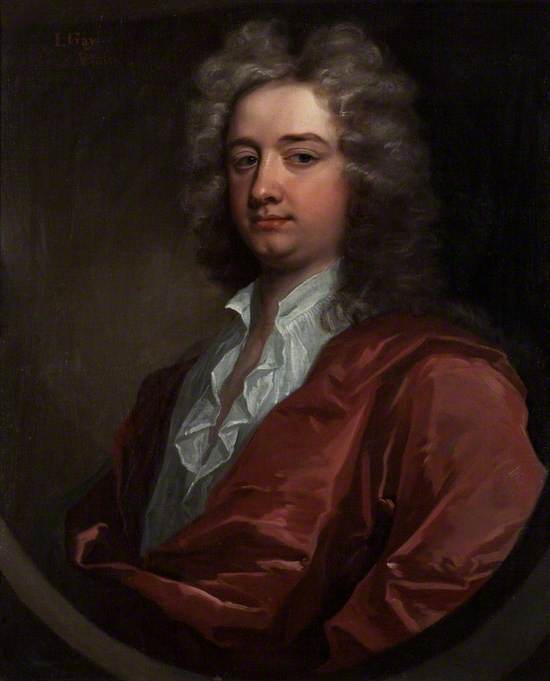
Photo credit: Victoria Art Gallery
Georgian and Regency Art
John Gay (1685-1732) was a poet and dramatist, best remembered for The Beggar's Opera, his famous carol opera.
J. Gay c.1738
Charles Jervas (c.1675–1739) (attributed to)
Oil on sheet
H 75 10 W 62 cm
Victoria Art Gallery
1750
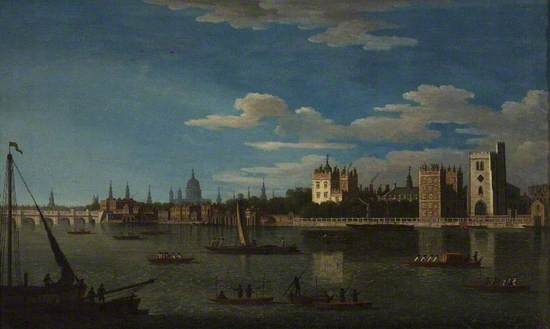
Photo credit: Victoria Art Gallery
Georgian and Regency Art
We are not certain who painted this picture, merely information technology is thought to exist past Samuel Scott. Scott painted views of London, particularly scenes of the River Thames.
Scott started his career painting Dutch-way maritime paintings, but he after adopted the style of the famous Venetian painter, Canaletto. Canaletto came to London in 1746. His views of the Thames at London and Windsor sold very well to wealthy fine art collectors. This success prompted Scott, and others, to imitate him.
Lambeth Palace, London c.1750
Samuel Scott (c.1702–1772) (attributed to)
Oil on canvas
H 59.4 ten W 99.vi cm
Victoria Art Gallery
.
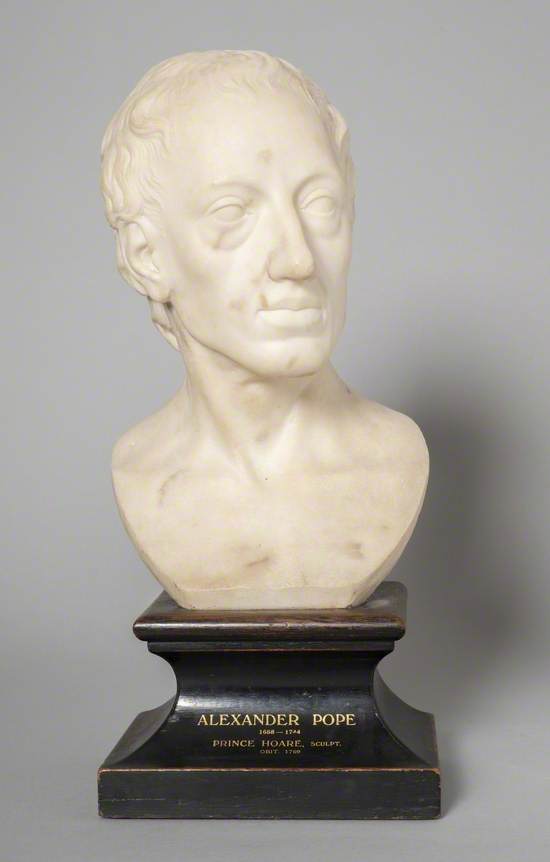
Photo credit: Victoria Art Gallery
Georgian and Regency Art
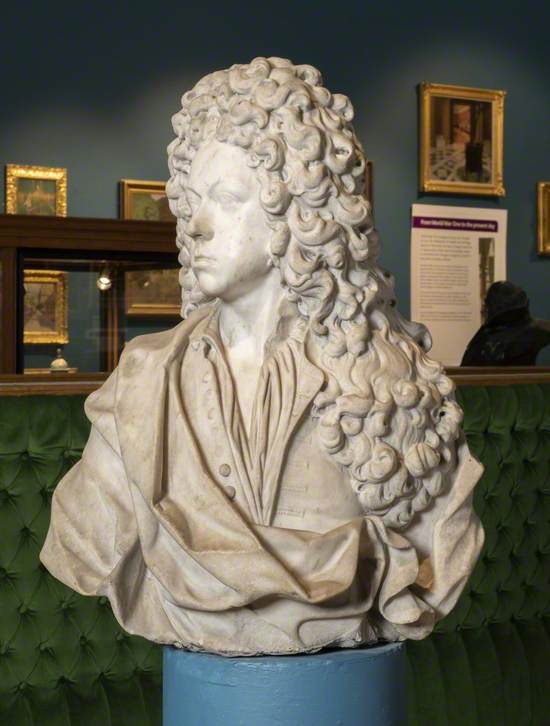
Alexander Pope was the foremost poet of the 18th century, best known for his satires.
Alexander Pope (1688–1744) mid-18th C
Prince Hoare the elderberry (1711–1769)
Marble
H 35 x W 16.6 10 D 14 cm
Victoria Art Gallery
1770
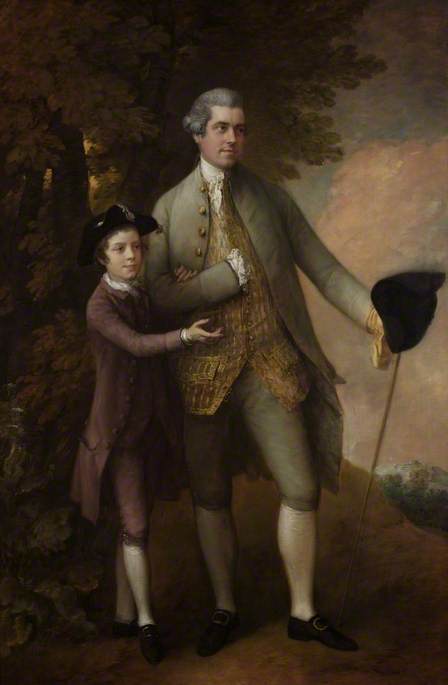
Photo credit: Victoria Art Gallery
Georgian and Regency Art
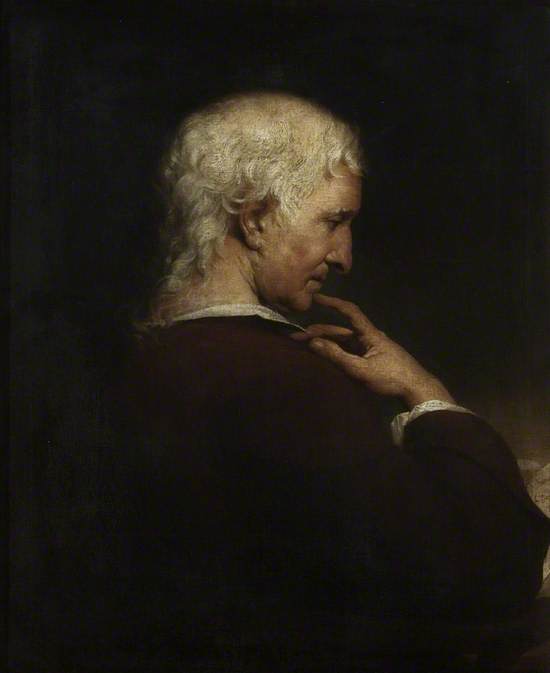
Thomas Gainsborough was the fifth son of a Suffolk cloth merchant. His conclusion to move his portrait studio to Bath in 1759 coincided with the city's fashionable heyday. He lived first in a spacious Georgian holding in Abbey Street, later moving to 17 Circus. In such august surroundings, he could entertain clients with witty chat, whilst applying equal nuance to his treatment of paint.
Thomas Rumbold and his son, William, sat for Gainsborough at 17 Circus in the early 1770s. Gainsborough probably painted their heads from life and roughed in the costume, leaving finer details to be added afterwards. He did non like painting hands and got away with including simply i on this occasion.
1772
Photograph credit: Victoria Fine art Gallery
Georgian and Regency Art
1778
Photograph credit: Victoria Art Gallery
Georgian and Regency Art
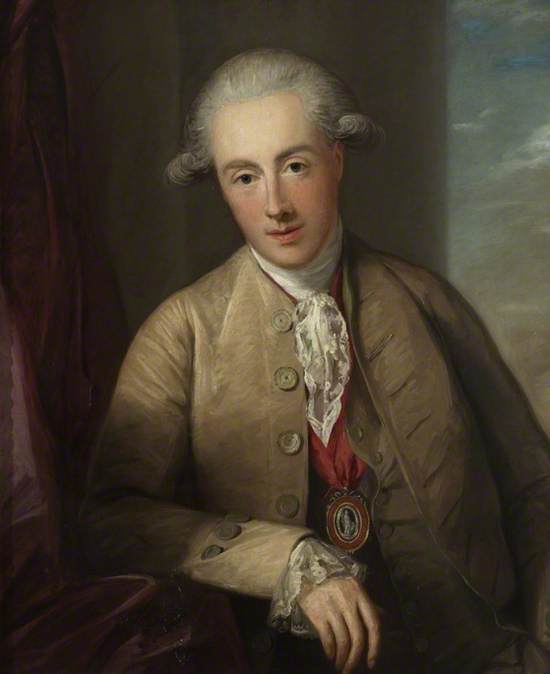
William Dawson was Master of Ceremonies at the Upper Assembly Rooms from 1777 to 1785. Here nosotros see him wearing his badge of office. The badge has Britannia on the front end, and a date 30 Oct 1777 on the opposite. Dawson's badge is now part of the local history collection at the Roman Baths Museum.
The chore of the Principal of Ceremonies was partly to maintain strict standards of etiquette and dress. In 1785, concerned about declining standards, Dawson placed a observe in the Bath press reminding visitors that the wearing of hats in the Rooms was only immune on ball or concert nights.
1780
Photograph credit: Victoria Art Gallery
Georgian and Regency Art
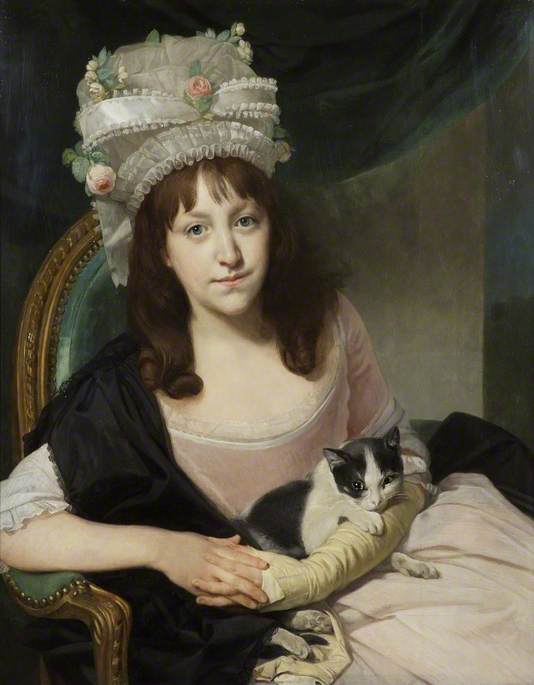
This is a picture of a French girl, anile about 12, painted past a German creative person, both living in London.
Sophia's father, Charles (below), brought her to England aged two or three. He was a dentist who worked for the royal family unit. She never married and kept house for her father when she grew up. She loved entertaining, giving dinner parties, and private concerts.
Johann Zoffany also worked for the majestic family. He was particularly skilled in painting children and made mannerly, informal portraits of the royal princes. In Sophia's portrait, with typical attention to item, he included her cat, her stylish headdress, and her bitten fingernails.
Sophia Dumergue (1768–1831) c.1780
Johann Zoffany (1733–1810)
Oil on panel
H 76 x Due west 61.5 cm
Victoria Fine art Gallery
1780
Photograph credit: Victoria Art Gallery
Georgian and Regency Art
.
Photograph credit: Victoria Art Gallery
Georgian and Regency Art
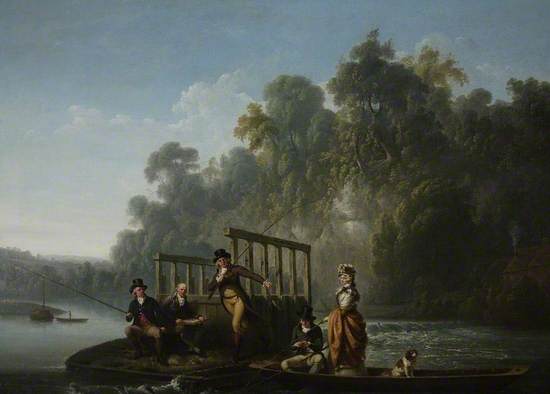
The Fishing Party
Joseph Farington (1747–1821) (attributed to)
Oil on canvas
H 154 x W 214 cm
Victoria Art Gallery
1786
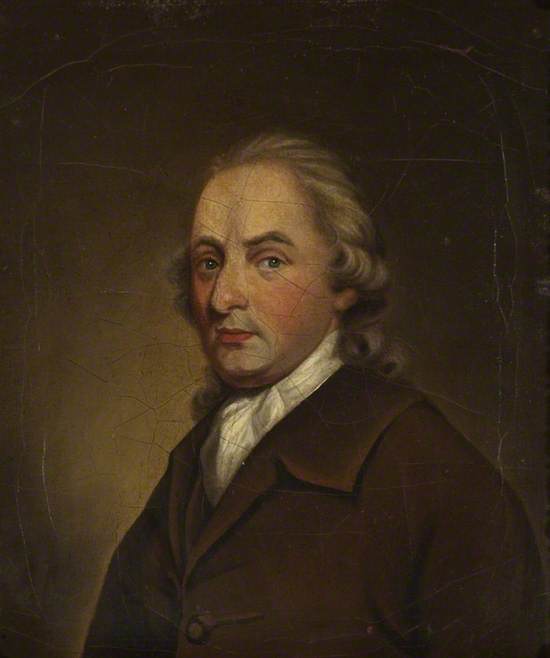
Photo credit: Victoria Art Gallery
Georgian and Regency Fine art
Roger Kemble was a theatre manager and actor. He set up a successful touring theatre company, the 'Warwickshire Visitor of Comedians'.
His significance is not so much down to his own career, merely the theatrical dynasty he founded. He and his actress wife, Sally Ward, had twelve children, v of which grew up to have a career on stage. The most celebrated was Sarah Siddons. As a young woman she appeared on the stage in Bath many times, before moving on to London's more than prestigious theatres. Siddons specialised in tragic roles, most famously as Lady Macbeth.
Roger Kemble (1721–1802) c.1786
Thomas Beach (1738–1806) (attributed to)
Oil on canvas
H 20.four 10 Due west 17.4 cm
Victoria Art Gallery
1789
Photograph credit: Victoria Art Gallery
Georgian and Regency Art
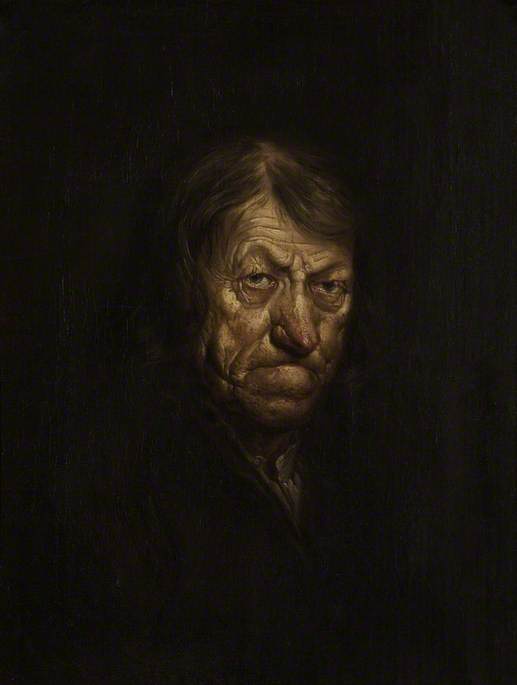
Richard Brent was a pedlar who worked the Bristol and Bath surface area. He was nicknamed Tom Pollex because he sold chapbooks: miniature story books for children priced at i or two pennies. He also hawked newspapers, garters, lace and other knick-knacks.
Brent had an exciting private life. He married four times, had 32 children and died in Bristol, blind and deaf, aged most 110.
Thomas Barker painted old 'Tom Pollex' at to the lowest degree three times. Bath ladies and gentlemen were so enthusiastic about this portrait that they raised money to give the pedlar a weekly income in his sometime historic period.
1789
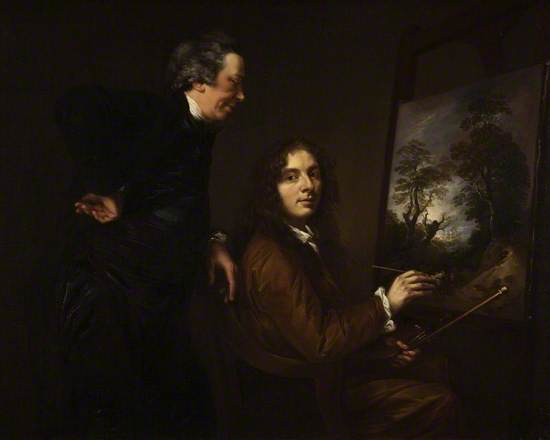
Photo credit: Victoria Fine art Gallery
Georgian and Regency Art
Thomas Barker came from a local family unit of artists. He is age 22 in this portrait and at the height of his success.
Looking over his shoulder is Charles Spackman, a local coach builder and property programmer. Spackman had recognised Barker's talent early and financed the boy's preparation. He had him educated and sent him to Rome.
Barker became very skilled at imitating other artists' styles. The flick on the easel hither looks only similar a landscape by Gainsborough.
After a few years in London, he returned hither and became an established and rather bourgeois Bath artist. Although his early portraits, like this one, are striking, his later piece of work showed less originality and more than sentimentality.
1791
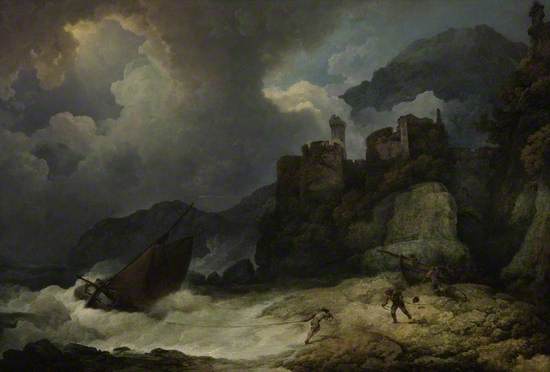
Photo credit: Victoria Fine art Gallery
Georgian and Regency Fine art
Philip de Loutherbourg was born in Strasbourg, the son of a miniature painter. He trained in France, but worked in England from 1771 onwards. His artistic career was successful, and he exhibited frequently at the Imperial Academy. In 1789 he gave upwards painting temporarily in order to concentrate on his other main interests – abracadabra and the supernatural.
In his 30s, Loutherbourg designed stage sets in London. Although he afterwards established his reputation as an artist, this painting, with its rugged, dramatic style, looks rather like theatrical scenery. Rather than being an accurate depiction of an actual place or event, this painting is the product of the artist's imagination.
A Tempest with Smuggler's Landing 1791
Philip James de Loutherbourg (1740–1812)
Oil on canvas
H 114.v x Due west 165 cm
Victoria Art Gallery
1795
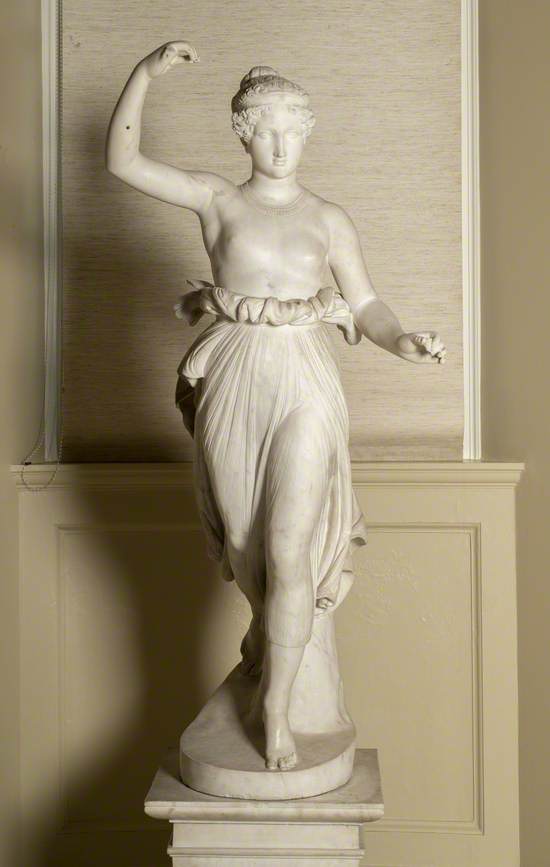
Photo credit: Victoria Art Gallery
Georgian and Regency Art
Hebe 1795
Antonio Canova (1757–1822) (copy after)
Marble
H 163 ten West 69 ten D 78 cm
Victoria Art Gallery
1812
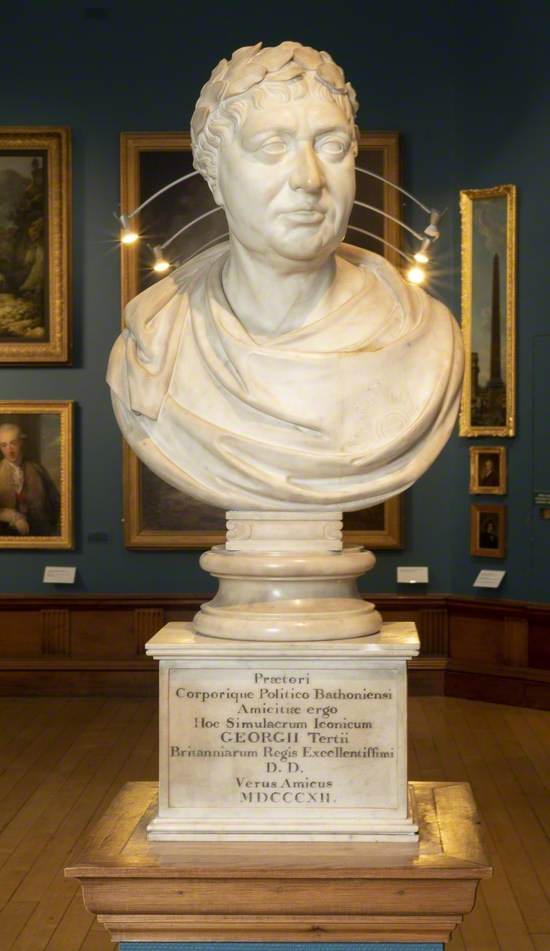
Photo credit: Victoria Fine art Gallery
Georgian and Regency Art
This idealised bosom of George III is classical in way. The king is shown looking strong and at-home. At that place has been much fence about George III's reputation, both during his long reign and since his death. His legacy is often linked to his illness and lack of control. Although this bust dates from a menstruum of the king's 'madness' Turnerelli's depiction far more sympathetic, in line with the popular image of the conscientious, dutiful monarch.
Peter Turnerelli was built-in in Ireland into an Italian family. Turning his back on his training for the priesthood, he followed in his father's footsteps and chose to go a sculptor. He trained in London and visited Rome, where he was influenced by the neoclassical style of Antonio Canova.
George 3 (1738–1820) 1812
Peter Turnerelli (1774–1839)
Marble
H 92 x W 56 x D 36 cm
Victoria Art Gallery
1816
Photograph credit: Victoria Art Gallery
Georgian and Regency Art
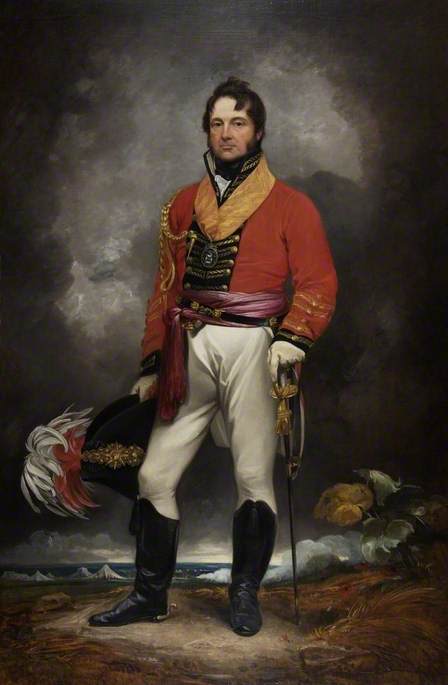
William Cockburn joined the ground forces in 1778. He served in America, Bharat and Ireland. On returning from India, he came to live in Bath. Cockburn had a keen interest in painting. He was an apprentice creative person and a friend of Thomas Barker, who painted this portrait.
Cockburn was a supporter of local charities. Afterwards his death a statement appeared in the Bathroom Chronicle: "his retentivity volition be embalmed by the tears of the needy, the destitute and the sick poor of the city, whose sorrows were soothed by his personal consolations and wants relieved by this large beneficence."
1819
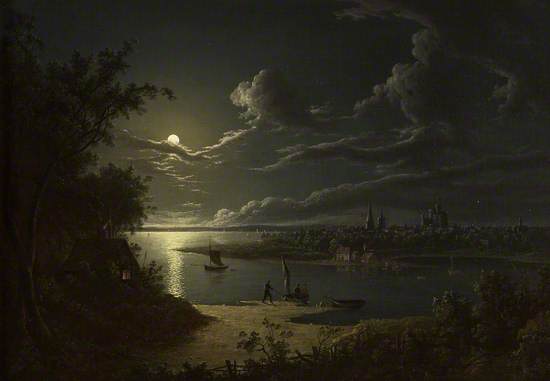
Photo credit: Victoria Art Gallery
Georgian and Regency Art
Sebastian Pether specialised in painting nighttime scenes. This 1 is very typical of his work. His best paintings e'er feature a vivid moon, reflections on water and rustic figures.
He imitated the artistic style of his male parent, Abraham, who was known as "Moonlight Pether". This rather formulaic arroyo proved successful for both father and son.
This painting might be of Southampton, some of the architectural details in this work are reminiscent of buildings in the early on 19th century city.
Moonlight Scene 1819
Sebastian Pether (1790–1844)
Oil on canvas
H 61.7 10 W 88.iii cm
Victoria Art Gallery
.
Photograph credit: Victoria Fine art Gallery
Georgian and Regency Art
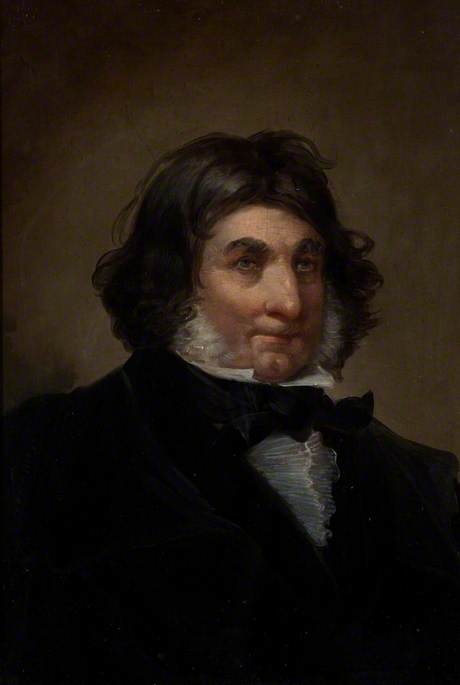
Self Portrait
Thomas Barker (1769–1847)
Oil on panel
H 22.5 10 W 15.1 cm
Victoria Fine art Gallery
1832
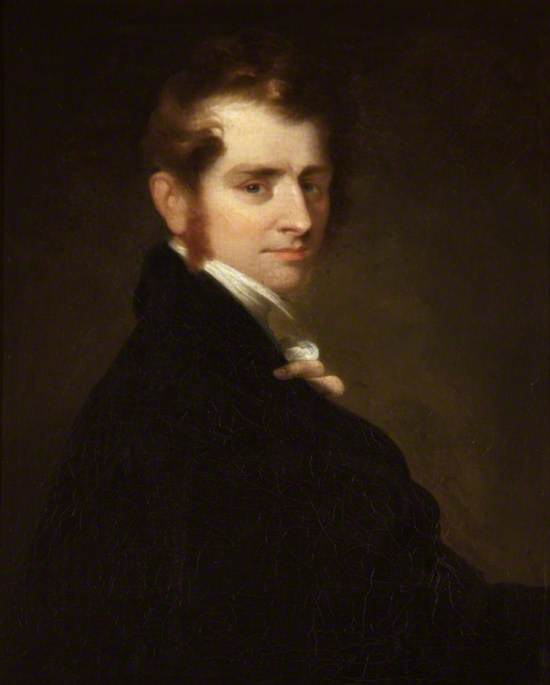
Photo credit: Victoria Art Gallery
Georgian and Regency Art
John Arthur Roebuck was a Member of Parliament for Bath from 1832 to 1847. He was a political radical and campaigned for all men to be given the vote. When he was first elected, there were but thirty voters in Bath.
Roebuck was known as a rabble-rouser with strong views, ever ready to enter an argument about political reform. The painting gives no clue as to his personality or political beliefs, equally he appears every inch the gentleman; full of poise and restraint.
Victorian and Edwardian Art
This was a catamenia of corking alter in Britain. Increasing industrialisation and imperial expansion meant that the rich got richer. A new center grade, with money to spend on art, emerged. For a certain blazon of person, having the right kind of objects in the abode became not merely more desirable, but also more affordable.
During this period British painting became more than diverse. Wealthy people no longer just bought portraits that they had commissioned. They were at present more likely to buy pictures of all sorts of subjects, views of cute countryside and maritime scenes sold well. Paintings that told a story became very pop. In an intensely religious society, pictures that looked at moral issues had broad appeal.
1837
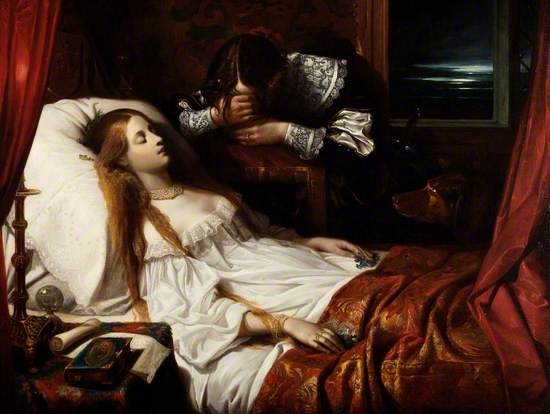
Photo credit: Victoria Art Gallery
Victorian and Edwardian Art
Thomas Jones Barker came from a local family unit of artists. At that place are pictures by his male parent and brothers in the drove. Dissimilar the rest of his family, he did not stay in Bath just had a successful career working in London and Paris.
This painting was for the daughter of Male monarch Louis Philippe of French republic. Information technology is Barker'southward most famous painting, and he won prizes and medals for it in French republic.
The picture tells a sad story. It is inspired by a ballad about the decease of a immature woman on the day earlier her wedding ceremony. Many of the objects in the picture show accept been chosen for their symbolic meanings. The hourglass beside the bed shows the passing of time and the shortness of life. The violets in her hand mean sadness and her pearls indicate purity.
The Bride of Expiry 1839
Thomas Jones Barker (1815–1882)
Oil on sail
H 124.5 x W 167.1 cm
Victoria Art Gallery
1846
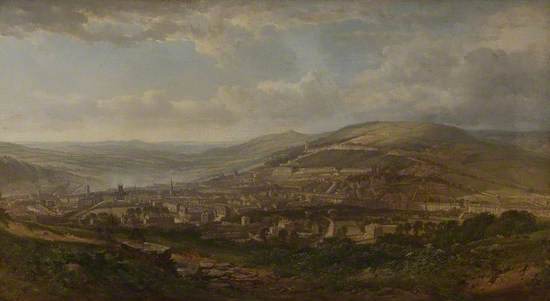
Photo credit: Victoria Art Gallery
Victorian and Edwardian Art
John Syer spent most of his life in Bristol and painted views of the Westward Country.
The newly built Dandy Western Railway is featured in this very detailed work. The railway line was intended to link Bristol with London, bolstering Bristol's condition as a business centre and major port. A marvel of Victorian technology, the railway boasted three viaducts, iv major bridges and seven tunnels in the stretch between Bath and Bristol lonely.
In this view we can just run across the original Bath Spa station, built in 1840, with a roof over the tracks.
View of Bath 1846
John Syer (1815–1885)
Oil on canvas
H 56 10 Westward 101.8 cm
Victoria Art Gallery
1852
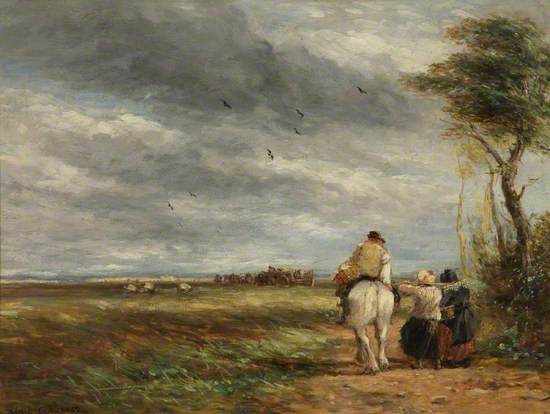
Photo credit: Victoria Art Gallery
Victorian and Edwardian Fine art
Going to the Hayfield 1852
David Cox the elder (1783–1859)
Oil on lath
H 28 ten W 36.7 cm
Victoria Art Gallery
1854
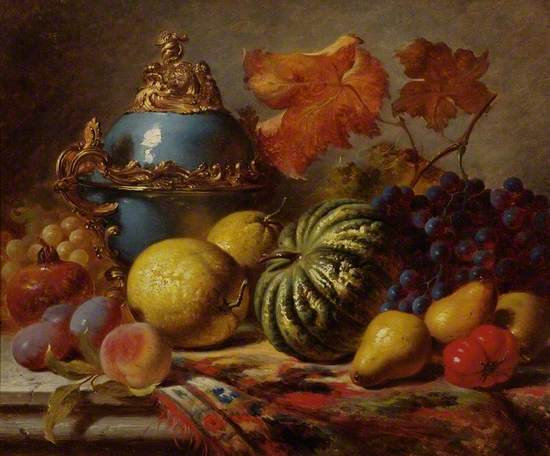
Photo credit: Victoria Fine art Gallery
Victorian and Edwardian Art
William Duffield was born in Bathroom, the son of a stationer and bookseller with a shop on Milsom Street. He specialised in still life painting – flowers, fruit, and occasionally expressionless birds and animals.
It is said that his decease, at the age of only 47, resulted from an infection he contracted from a expressionless stag he was painting. Because Duffield had lost his sense of smell, he was unable to detect the dead animate being's dangerous state.
Yet Life, Fruit c.1854
William Duffield (1816–1863)
Oil on canvas
H 28.1 x W 33.iii cm
Victoria Art Gallery
1860
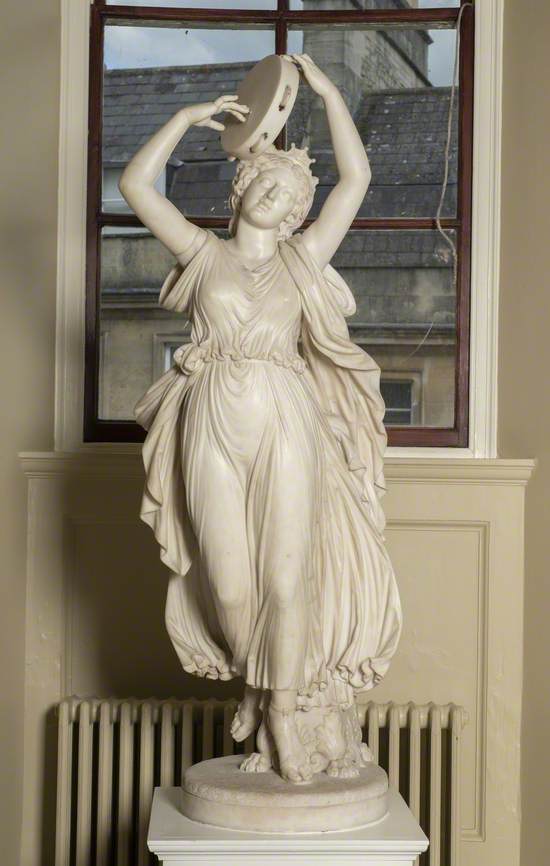
Photo credit: Victoria Art Gallery
Victorian and Edwardian Art
Jephthah's Daughter 1860
John Warrington Wood (1839–1886)
Marble
H 167 x W 47 ten D 58 cm
Victoria Art Gallery
1869
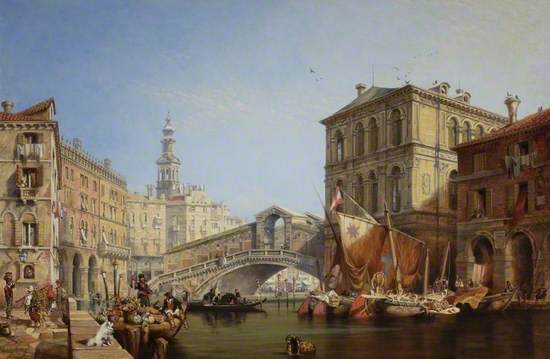
Photo credit: Victoria Art Gallery
Victorian and Edwardian Art
The Rialto Bridge, Venice 1869
Calvert Richard Jones (1804–1877)
Oil on canvas
H 99.1 x Westward 147.3 cm
Victoria Art Gallery
1869
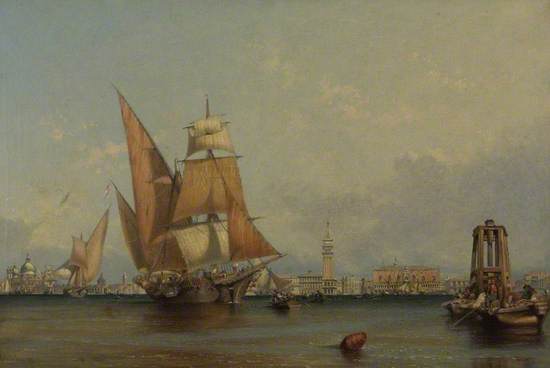
Photo credit: Victoria Art Gallery
Victorian and Edwardian Art
The Dogana, Venice 1869
Calvert Richard Jones (1804–1877)
Oil on canvas
H 92.five x W 138 cm
Victoria Fine art Gallery
1870
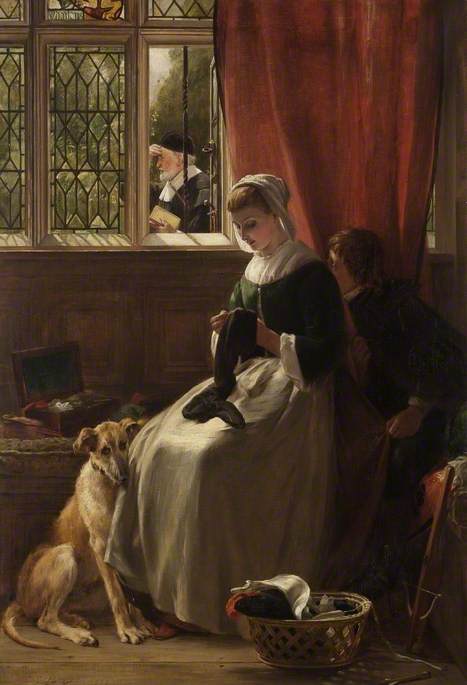
Photo credit: Victoria Art Gallery
Victorian and Edwardian Fine art
The Truant in Hiding 1870
John Callcott Horsley (1817–1903)
Oil on canvas
H 74.3 x Due west 71.7 cm
Victoria Art Gallery
.
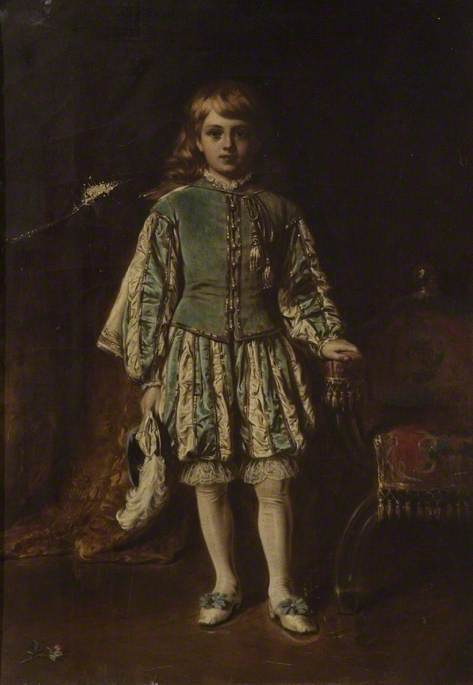
Photograph credit: Victoria Art Gallery
Victorian and Edwardian Art
My Lady'southward Page
John Robert Dicksee (1817–1905)
Oil on canvas
H 32.5 x W 23 cm
Victoria Art Gallery
1876
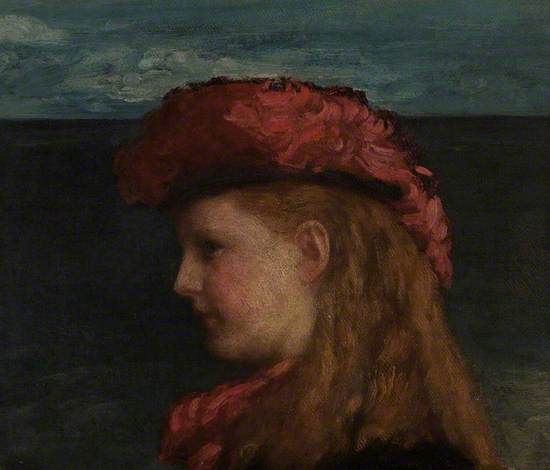
Photo credit: Victoria Art Gallery
Victorian and Edwardian Fine art
Past the Bounding main
George Frederic Watts (1817–1904)
Oil on canvas
H 40.5 x W 48 cm
Victoria Art Gallery
1879
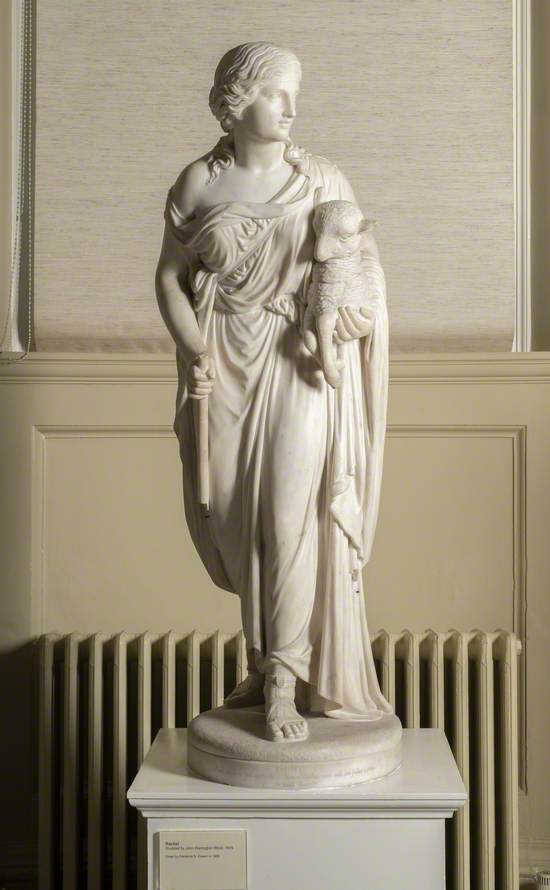
Photo credit: Victoria Art Gallery
Victorian and Edwardian Art
Rachel 1879
John Warrington Wood (1839–1886)
Marble
H 127 ten W 42 x D 55 cm
Victoria Art Gallery
1883
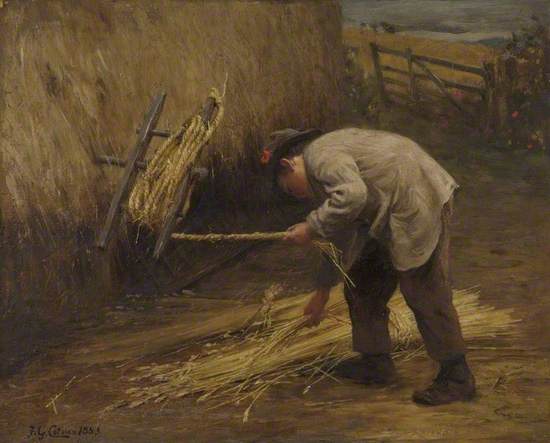
Photo credit: Victoria Art Gallery
Victorian and Edwardian Art
Spinning Thatch Bands 1883
Frederick George Cotman (1850–1920)
Oil on canvas
H twenty.3 x W 25 cm
Victoria Art Gallery
1884
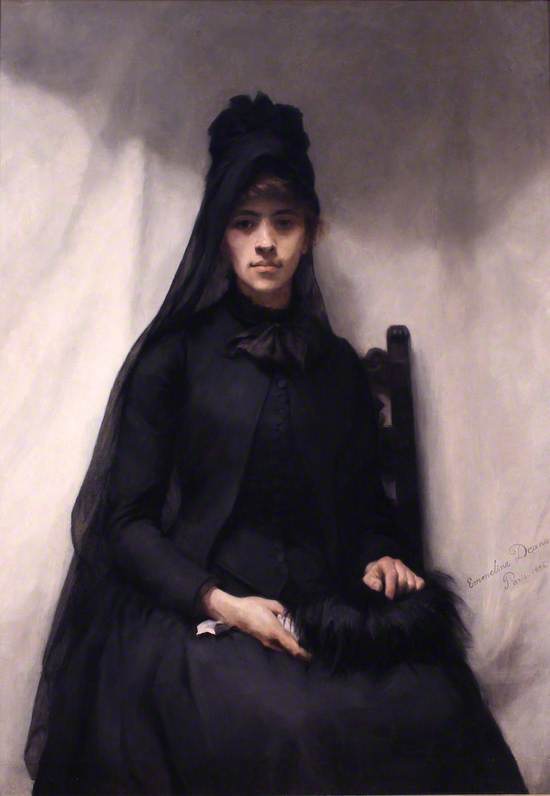
Photo credit: Victoria Fine art Gallery
Victorian and Edwardian Art
The sitter in this dramatic portrait is Polish artist Anna Bilinska-Bohdanowicz. Artist and sitter probably met in Paris in 1884, where Bilinska was studying on an art course for women.
In this portrait, Bilinska is shown wearing typical mourning dress, with what may be a black feather fan resting on her lap. In 1884, Anna's father had died leaving her impoverished. A year subsequently her fiancé as well died. In deep despair she travelled circular France sketching and painting landscapes. Subsequently marrying in 1892 she had plans to set up upward an art school for women in Warsaw but died tragically young of eye disease, then her dream was never realised.
Anna Bilinska (1857–1893) 1884
Emmeline Deane (1858–1944)
Oil on canvas
H 128 x Due west 90.seven cm
Victoria Fine art Gallery
1884
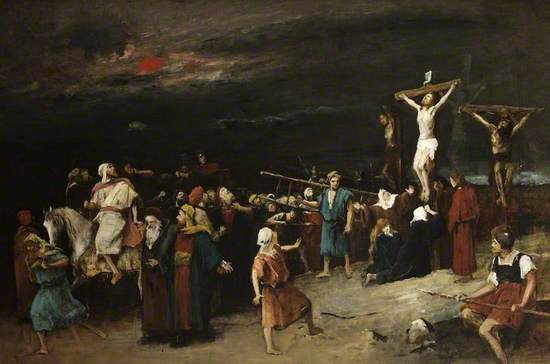
Photo credit: Victoria Art Gallery
Victorian and Edwardian Art
Mihály Munkácsy was a leading Hungarian Realist painter who enjoyed international fame in the later nineteenth century afterwards winning a gilt medal at the Paris Salon of 1870.
Calvary is the climax to the artist's monumental trilogy on the passion of Christ. Munkácsy's estimation of the Crucifixion is particularly dramatic, an issue accomplished through employment of light. Tintoretto was an important influence on the trilogy. In the grade of working on the Crucifixion, Munkácsy had himself suspended from a crucifix, apparently in order to identify with Christ'southward suffering.
Calvary
Mihály Munkácsy (1844–1900)
Oil on canvas
H 117 x Westward 170 cm
Victoria Art Gallery
1887
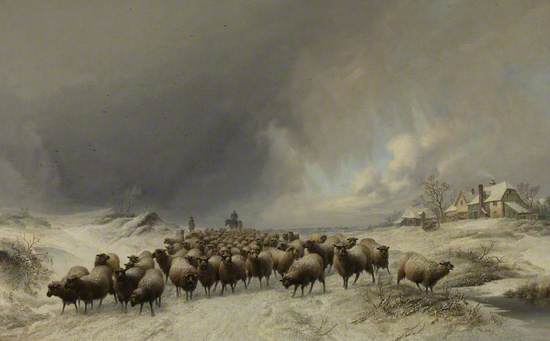
Photo credit: Victoria Art Gallery
Victorian and Edwardian Art
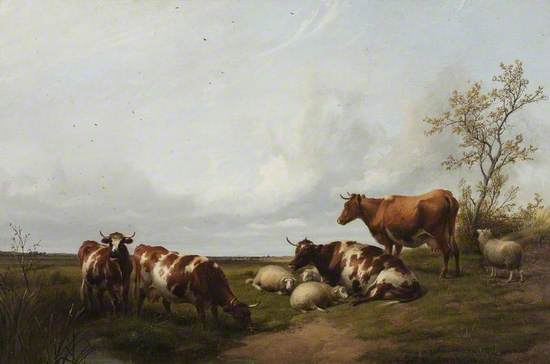
To Market in a Snow Drift 1887
Thomas Sidney Cooper (1803–1902)
Oil on sail
H 96.6 x W 154.9 cm
Victoria Art Gallery
1889
Photograph credit: Victoria Art Gallery
Victorian and Edwardian Art
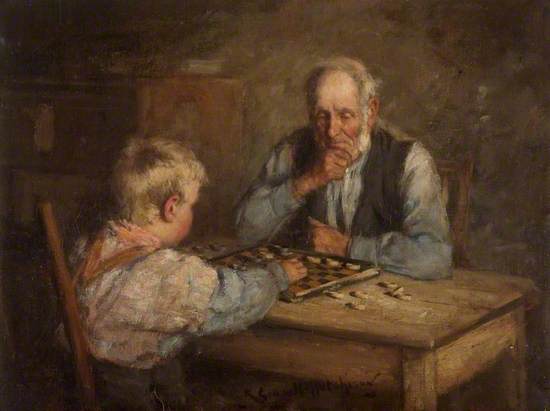
This is a charming domestic scene. The subtitle of the painting adds further character: 'They Would Play for Hours and Finish in a Describe'.
Built-in in Edinburgh, Robert Gemmell Hutchison worked in an Impressionistic way now recognised as being typical of the Scottish School of this period. He used distinctive broad brushstrokes and soft, muted colours. He particularly favoured scenes of uncomplicated domesticity, oft featuring children.
The Draught Players c.1890
Robert Gemmell Hutchison (1855–1936)
Oil on sail
H 29.3 ten W 39.half dozen cm
Victoria Art Gallery
1889
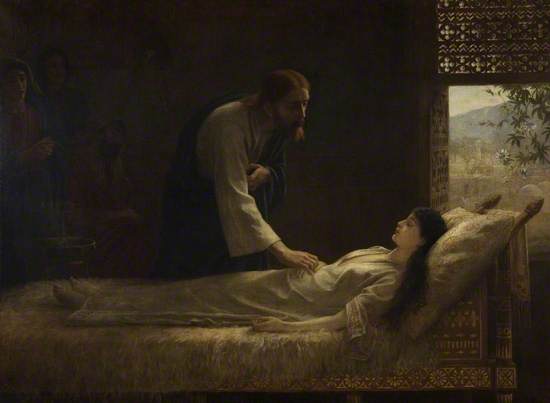
Photo credit: Victoria Art Gallery
Victorian and Edwardian Art
This painting illustrates a miracle performed by Jesus in the gospel of St Mark: "And he took the damsel by the mitt and said….Damsel I say unto thee, arise". The artist shows the nigh dramatic moment just before the girl comes back to life. Her parents and a disciple sentry with apprehension as the phenomenon takes place. The window to the correct of the picture lights the scene and gives united states of america a view of the city of Nazareth.
Edwin Long was built-in at Kelston, about Bath, and worked hither as a portrait painter. He moved to London in the 1850s and became a very successful artist, painting Middle Eastern scenes populated with beautiful young women.
1889
Photograph credit: Victoria Art Gallery
Victorian and Edwardian Fine art
1895
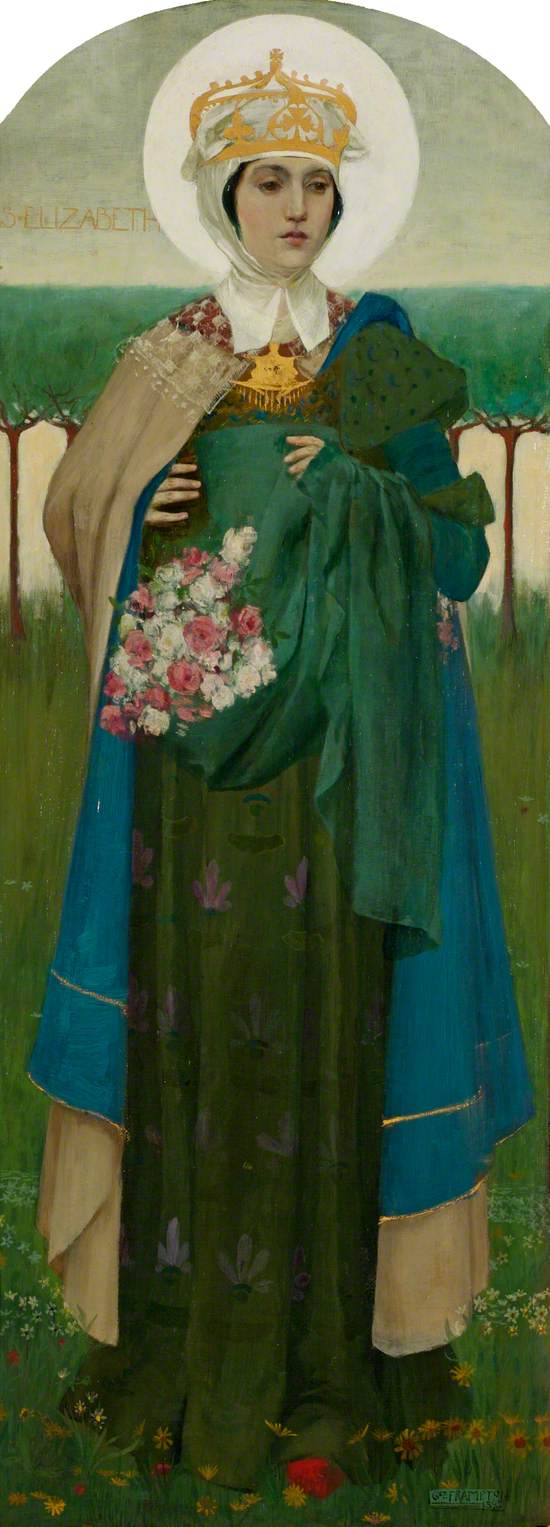
Photo credit: Victoria Art Gallery
Victorian and Edwardian Art
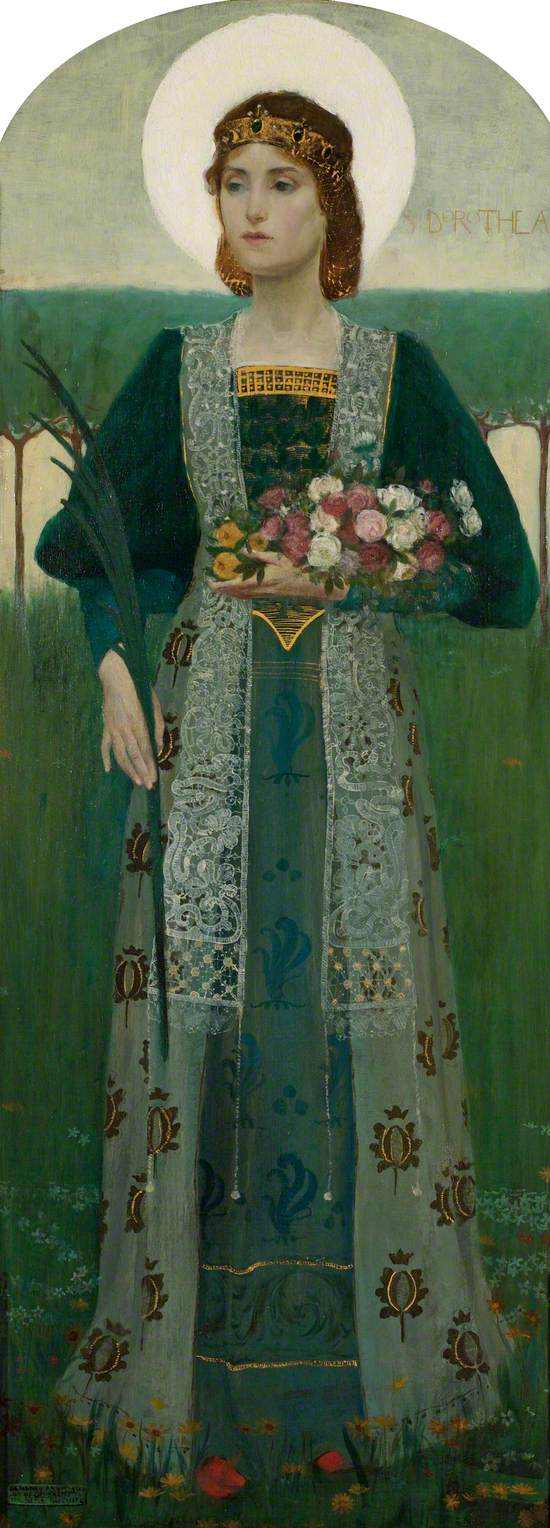
This and the painting below adorn the panels of a screen. The other panels depict a rose tree and an apple tree. St Dorothea is the patron saint of florists. The frieze to a higher place the saints is busy with mother of pearl and ivory, the four rear panels are covered with blue silk brocade.
George Frampton was a leading effigy in the Arts and Crafts Motility and a member of the Fine art Workers' Lodge.
Saint Elizabeth of Hungary 1895
George James Frampton (1860–1928)
Oil on panel
H 96.3 x W 35.five cm
Victoria Art Gallery
1895
Photograph credit: Victoria Art Gallery
Victorian and Edwardian Art
Saint Dorothea 1895
George James Frampton (1860–1928)
Oil on panel
H 96.3 10 W 35.5 cm
Victoria Art Gallery
1898
Photograph credit: Victoria Art Gallery
Victorian and Edwardian Fine art
1898
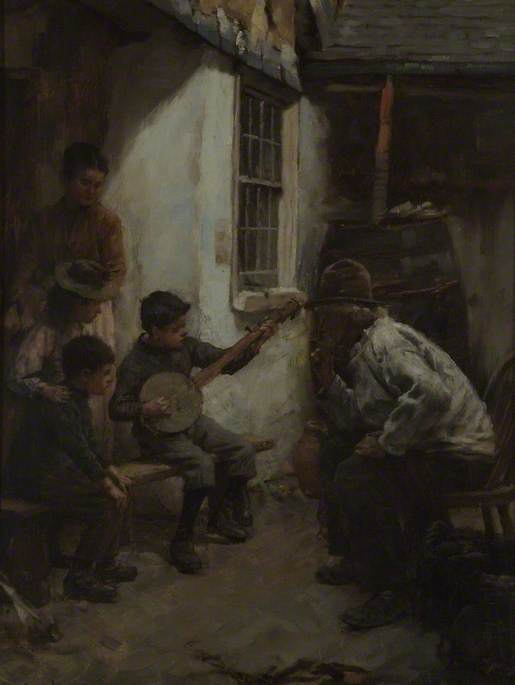
Photo credit: Victoria Fine art Gallery
Victorian and Edwardian Art
Walter Langley was 1 of a grouping of artists who settled in the small-scale fishing village of Newlyn in Cornwall. They painted the ordinary people of the village going about their normal lives. Langley said that his interest was in 'the workers and the toilers'.
Similar some gimmicky French artists, the Newlyn School of painters worked outdoors to brand their pictures await more realistic.
Admiration
Walter Langley (1852–1922)
Oil on panel
H 40 x West 31 cm
Victoria Art Gallery
1900
Photograph credit: Victoria Fine art Gallery
Victorian and Edwardian Art
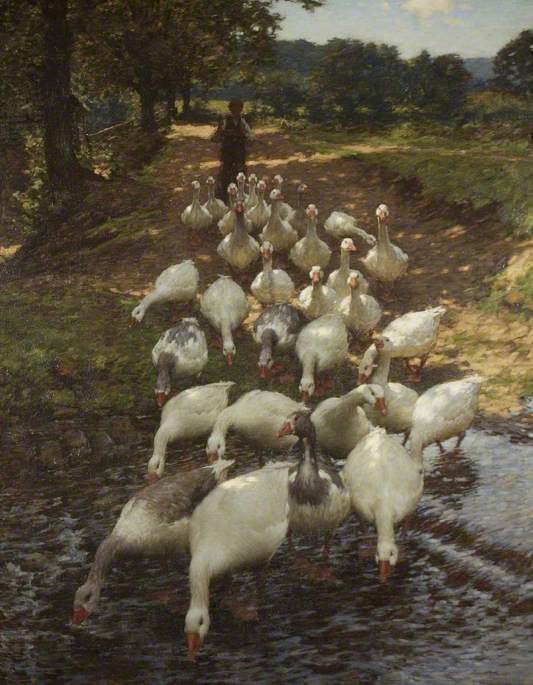
Henry La Thangue spent three years in France every bit part of his training. He was fascinated by plein-air (outdoor) painting and spent his summer holidays on sketching trips in Brittany.
La Thangue painted several pictures showing a kid or adult driving flocks of geese or ducks. Here the peaceful atmosphere of a summer'south day is conveyed by dappled sunlight. Light is crucial to his painting. A fellow artist remarked 'that it was the dazzler of things in sunlight that excited him'.
The Watersplash 1900
Henry Herbert La Thangue (1859–1929)
Oil on canvass
H 116.viii x West 94 cm
Victoria Art Gallery
1900
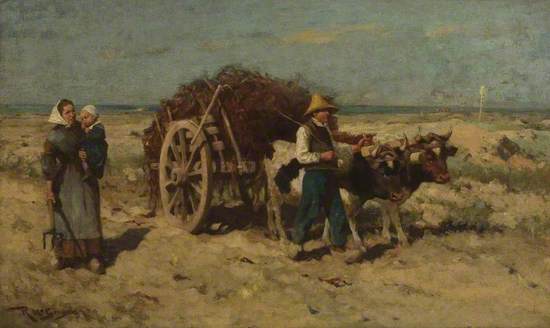
Photo credit: Victoria Fine art Gallery
Victorian and Edwardian Art
Goemon, Normandy, France
Robert McGregor (1847–1922)
Oil on canvas
H 67 x W 106.vii cm
Victoria Art Gallery
1900
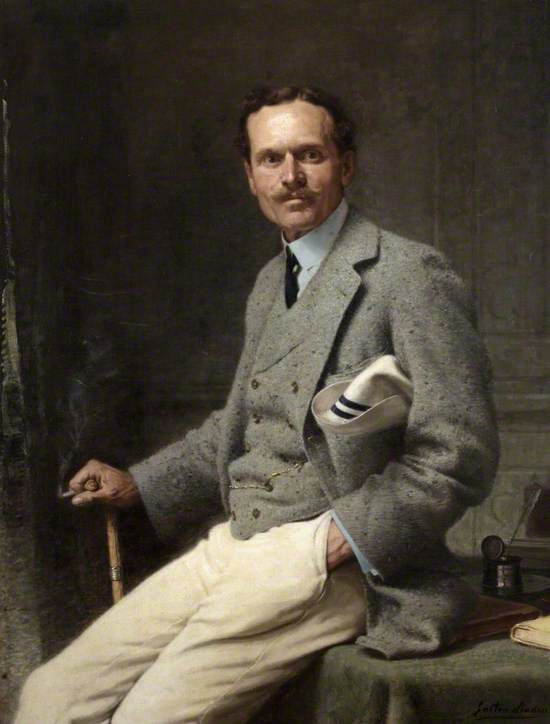
© the copyright holder. Photo credit: Victoria Art Gallery
Victorian and Edwardian Art
1904
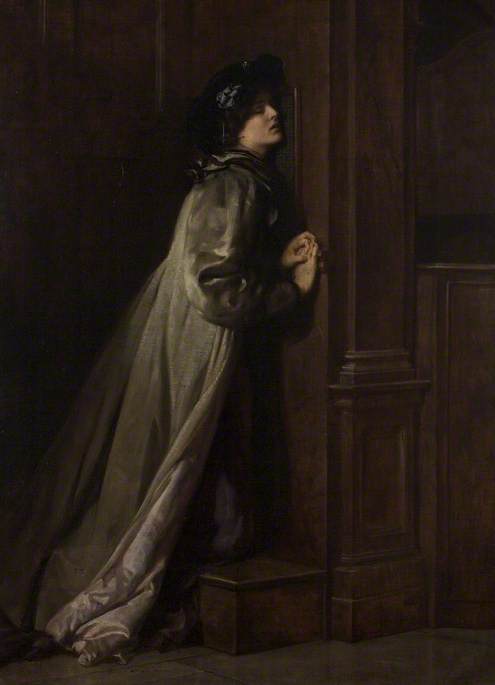
Photo credit: Victoria Fine art Gallery
Victorian and Edwardian Art
The Sinner 1904
John Collier (1850–1934)
Oil on sheet
H 147.3 x W 108 cm
Victoria Art Gallery
1905
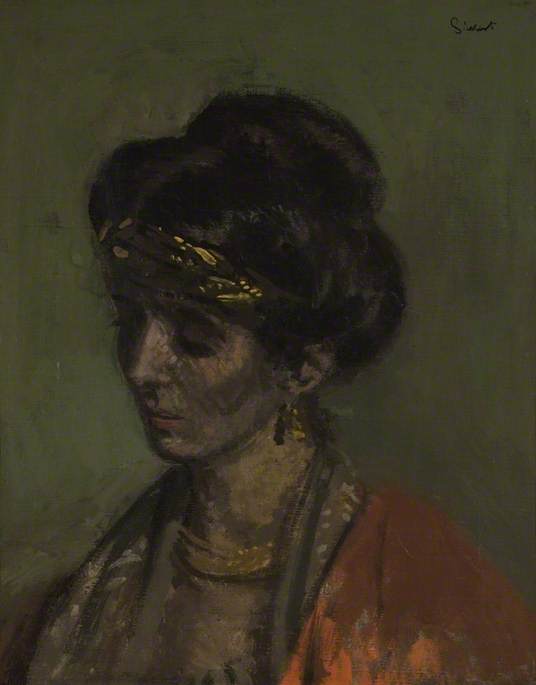
Photo credit: Victoria Art Gallery
Victorian and Edwardian Art
Celia Brunel was the granddaughter of Isambard Kingdom Brunel, the famous engineer who built the Clifton Suspension Span and the SS Great Britain.
Walter Sickert despised professional portrait painters, describing them equally 'the wriggle-and-chiffon school'. He still produced powerful portraits throughout his life. Here he has used thick paint and lively brushstrokes to capture his elegant sitter'due south features in a moment of idea.
Celia Brunel, Lady Noble 1905
Walter Richard Sickert (1860–1942)
Oil on canvas
H l.eight 10 Westward 40.6 cm
Victoria Art Gallery
1905
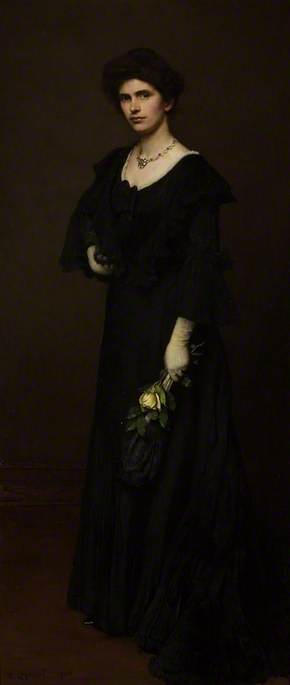
Photo credit: Victoria Art Gallery
Victorian and Edwardian Art
The Artist's Wife c.1905
William Logsdail (1859–1944)
Oil on canvas
H 200.vii x Due west 85 cm
Victoria Art Gallery
1910
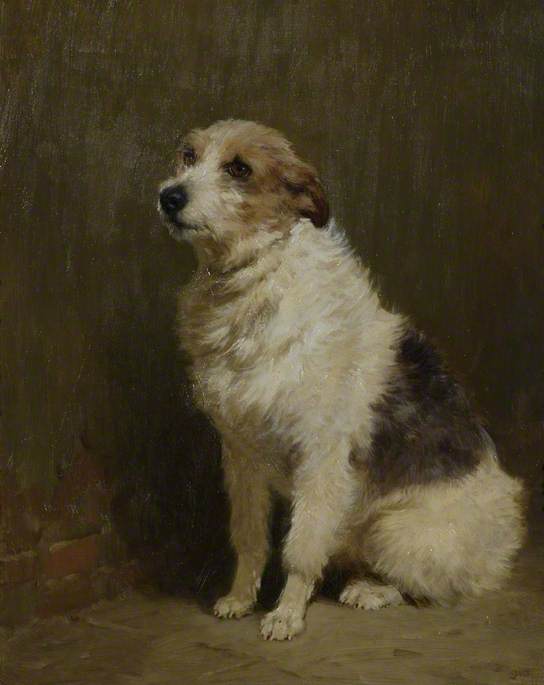
Photograph credit: Victoria Art Gallery
Victorian and Edwardian Art
Pilu was something of a celebrity. He performed all over the globe, apparently answering maths questions by turning upwardly correct figures with his mitt. He plainly made a fortune for his owner! He tragically died in Pisa in 1910, the yr this was painted, when he was run over and killed by a truck.
Dogs have long been used in fine art to symbolise unconditional loyalty. They were a favourite subject area for Victorian artists, such as John Charlton, who specialised in animal paintings. He was said to be particularly good at painting foxhounds and, above all, at capturing their personalities.
1911
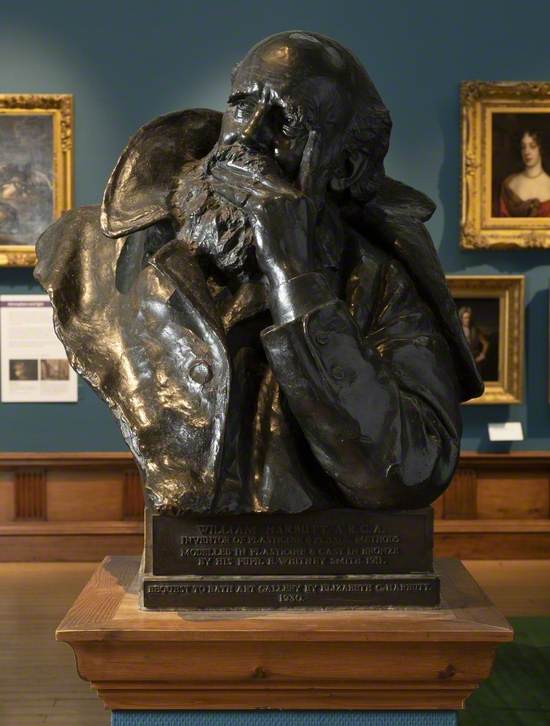
© the copyright holder. Photo credit: Victoria Art Gallery
Victorian and Edwardian Fine art
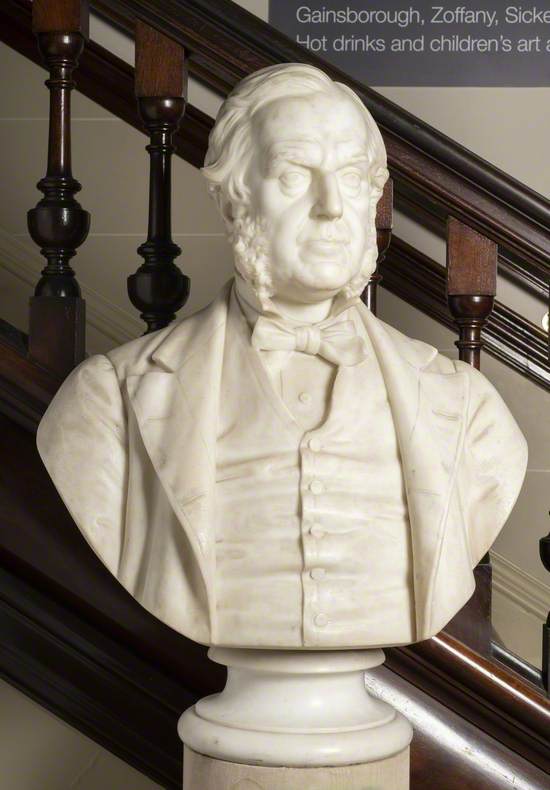
William Harbutt was born in Newcastle and came to Bath in 1874, to work as headmaster at Bath School of Fine art. Around 1897, Harbutt invented the modelling material Plasticine. Initially, Harbutt regarded Plasticine as a teaching aid rather than a commercial production. He invented it specifically for his students to apply, as the clay then used for modelling was heavy and difficult to use. The Harbutt Plasticine concern, based at Bathampton from 1900, was very successful.
William Harbutt (1844–1921) 1911
Edwin Whitney-Smith (1880–1952)
Statuary
H 73 x W 55 x D 47 cm
Victoria Art Gallery
.
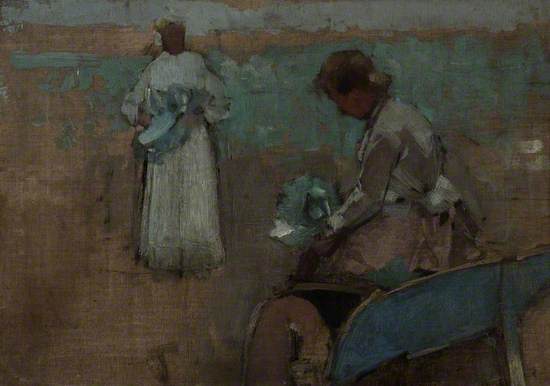
Victorian and Edwardian Art
World War I to the Nowadays Day
Earth War I changed order, and art also. The celebration of privilege typical of Edwardian art was no longer as welcome. Artists were increasingly drawn to document the changes wrought by wartime and paint everyday subjects.
The early on 20th century was a period of exploration and experimentation in British art. Artists were keen to paint not just the mere appearance of things, but to try to go deeper and arroyo their subjects in new ways. Artists such as Walter Sickert and William Roberts were amongst the innovators.
The second half of the 20th century saw the advent of the Cold War and the threat posed past nuclear weapons. A new sense of unease was reflected in art. Many painters took their lead from America and worked in abstraction.
1914
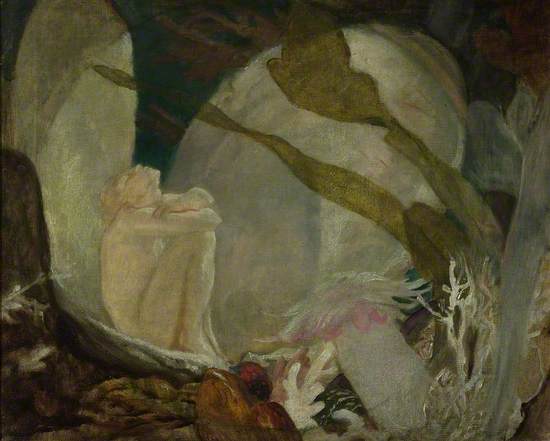
Photograph credit: Victoria Art Gallery
World State of war I to the Nowadays 24-hour interval
In 1953, Reg Wright, who was then Curator of the Gallery, found this painting underneath Glyn Warren Philpot'southward "The Skyscraper". Presumably, the creative person had simply stretched another canvas over the elevation of this picture, thinking that it was worthless.
The Pearl is a study for a larger painting entitled "Under the Sea". Reg Wright, not the creative person, chose the title "The Pearl" for this picture.
The Pearl 1914
Glyn Warren Philpot (1884–1937)
Oil on sail
H 51 ten W 61.4 cm
Victoria Art Gallery
1917
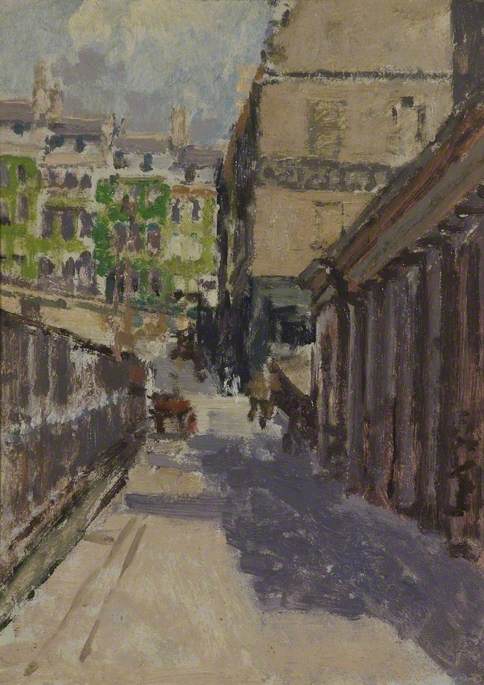
Photo credit: Victoria Art Gallery
World War I to the Present Day
Walter Sickert trained every bit an actor before studying art. He painted music halls and seedy lodging house interiors, and enjoyed sophisticated London guild. He worked with Degas in Dieppe and for several years divided his time between Dieppe and Venice. The artist also has strong Bath connections. He spent some fourth dimension here during the First World War and later settled in Bathampton for the last four years of his life.
1918
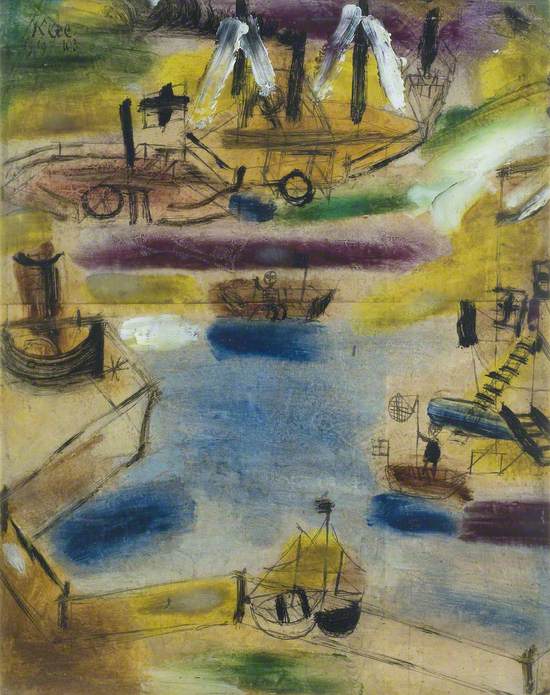
Photo credit: Victoria Art Gallery
Globe War I to the Present Day
This tiny jewel-like painting tells an extraordinary story. It was painted past the Swiss Expressionist Paul Klee. He painted it mid-career when he was on the cusp of international distinction. Materials were scarce then Klee recycled role of an older portrait equally a backing to the painting.
When German hyper-inflation forced its first owner to sell up, the painting was acquired by a Jewish family, the Habers. They fled Federal republic of germany and, as it was so small, took the picture show with them. It was the son of the family, Lutz Haber, who eventually ended up in Bath. He treasured the painting his whole life and bequeathed it to the Gallery.
Small Harbour Scene 1919
Paul Klee (1879–1940)
Oil on paper on board
Victoria Fine art Gallery
1920
Photograph credit: Victoria Art Gallery
Earth War I to the Nowadays Day
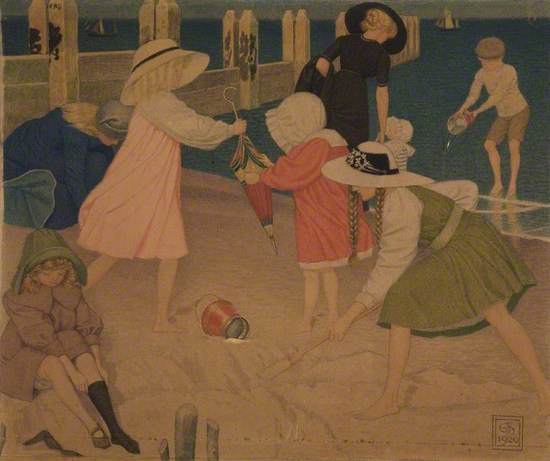
Joseph Southall worked with, and promoted, a revival in the use of tempera paint. Children at Play is painted in this egg-based medium. It is hard to work with every bit, unlike oil paint, you lot cannot paint over it. Yet, when successfully mastered the colours and effects accomplished are beautiful.
Children at Play 1920
Joseph Edward Southall (1861–1944)
Tempera on board
H 33 x W 39 cm
Victoria Art Gallery
1924
© the copyright holder. Photograph credit: Victoria Art Gallery
World War I to the Present Day
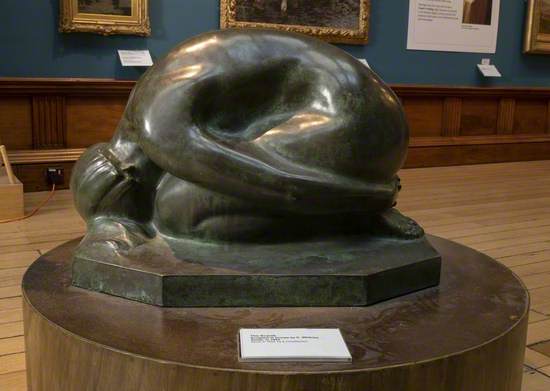
Edwin Whitney-Smith was born in Bath and studied at Bath and Bristol Schools of Art. He trained under William Harbutt, the inventor of Plasticine. Whitney-Smith spent most of his working life in London, and exhibited at the Royal University and Paris Salon, specialising in portrait sculptures in bronze and marble.
A scarab is a type of ancient Egyptian amulet or amuse. One side would exist covered with hieroglyphics or charms, the other would be in the shape of a sacred protrude. The shape of this sculpture, the way the figure is crouching, is reminiscent of a scarab amulet.
The Scarab 1924
Edwin Whitney-Smith (1880–1952)
Statuary
H 48 x W 47 x D 69.5 cm
Victoria Art Gallery
1927
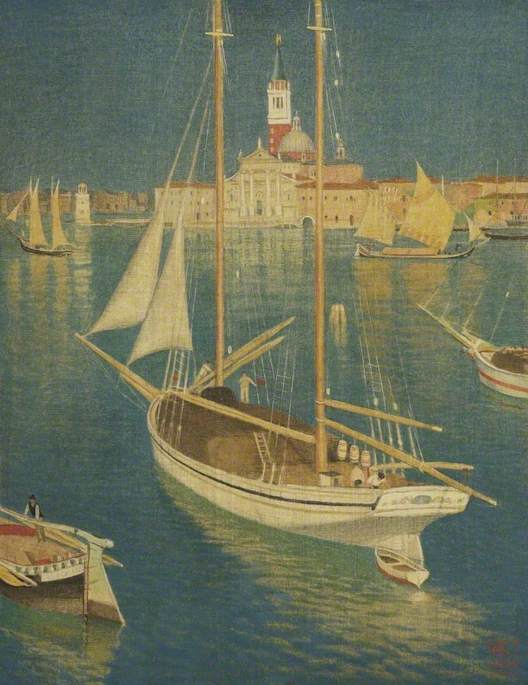
Photo credit: Victoria Fine art Gallery
World War I to the Present Day
San Giorgio, Venice 1927
Joseph Edward Southall (1861–1944)
Tempera on board
H 34 x W 26.8 cm
Victoria Art Gallery
1927
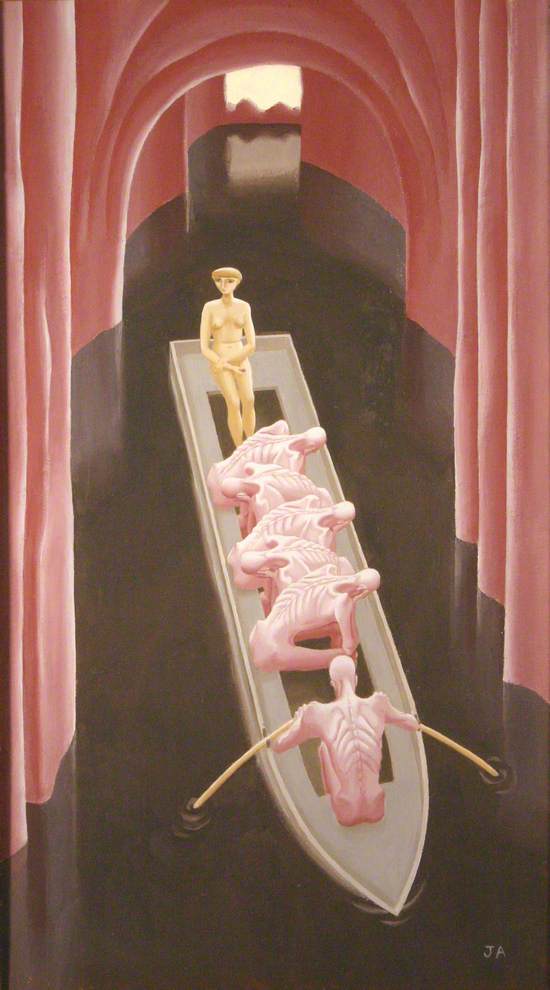
World State of war I to the Present Twenty-four hour period
John Armstrong painted imaginative and classical subjects. His approach to painting was systematic – he normally started in the top left-mitt corner and worked across and downwardly, finishing every function as he progressed. In the 1930s, after seeing the piece of work of the Surrealist painter de Chirico, Armstrong's way became increasingly dreamlike. Armstrong besides painted stage sets and murals, including a ceiling painting for Bristol'due south quango chamber.
Psyche Crossing the Styx 1927
John Armstrong (1893–1973)
Tempera on board
H 64 x W 36 cm
Victoria Art Gallery
1927
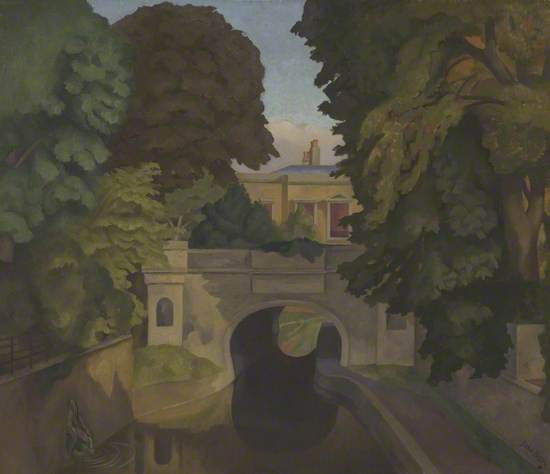
World War I to the Present Day
The bridge crosses the Kennet and Avon Culvert in the middle of Sydney Gardens. Having been conceived equally a romantic landscape, Sydney Gardens soon experienced the impact of the industrial revolution. They were cut through kickoff by the Kennet and Avon Culvert and and so the Great Western Railway.
The Culvert was built between 1796 and 1810 to let the transport of goods between the Avon and the Thames. The engineer was John Rennie, and most of the bridges were also designed by him. Nash'south picture is one of a serial of views of Bath painted after his visit here in 1925. These are among the few urban views he ever painted, for he was inspired primarily past the English landscape.
1930
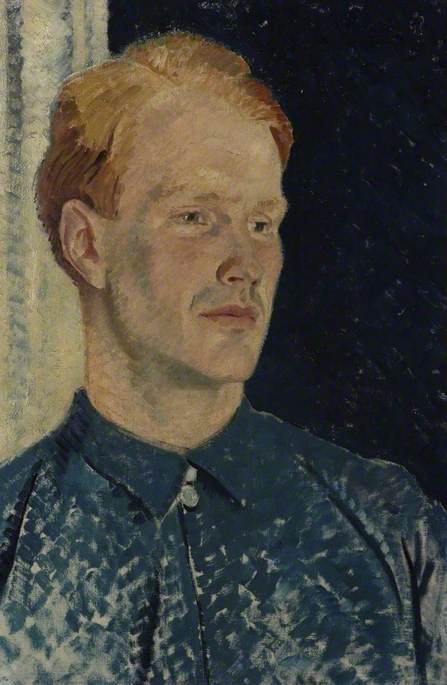
Photo credit: Victoria Art Gallery
World State of war I to the Present Day
Frank Coombs was born in Radstock. In the 1930s he worked at the Storran Gallery, a commercial art gallery in London. Together with a painter, Eardley Knollys, Coombs organised a remarkable series of exhibitions there, featuring works by Picasso, Modigliani and Utrillo, besides as by leading British artists including Philpot. Coombs was killed during World State of war Two, aged only 35.
Frank Coombs (1906–1941) c.1930
Glyn Warren Philpot (1884–1937)
Oil on sail
H 55 x Due west 38 cm
Victoria Art Gallery
1930
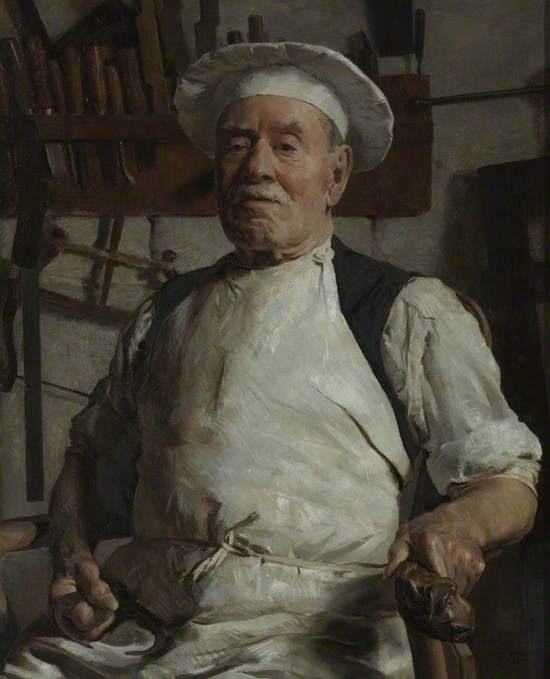
Photograph credit: Victoria Art Gallery
World War I to the Present 24-hour interval
Born in Walcot, Bath, Charles Bakery was a skilled cabinetmaker and upholsterer. He specialised in the reproduction of antiquarian furniture. Educated at the 'penny-a-week' school on Republic of guinea Lane, he went into the piece of furniture concern immediately subsequently leaving school. He ready a company that fabricated 100 chairs for the Banqueting Room in the Guildhall and a cabinet for Queen Victoria'southward doll's house. This picture was painted the year after he retired, aged 88.
1930
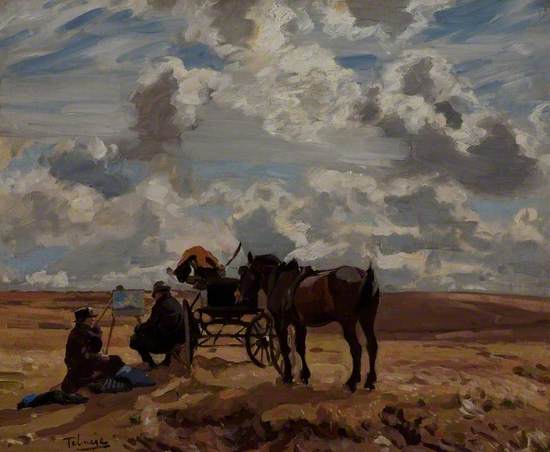
Photo credit: Victoria Art Gallery
World War I to the Present Day
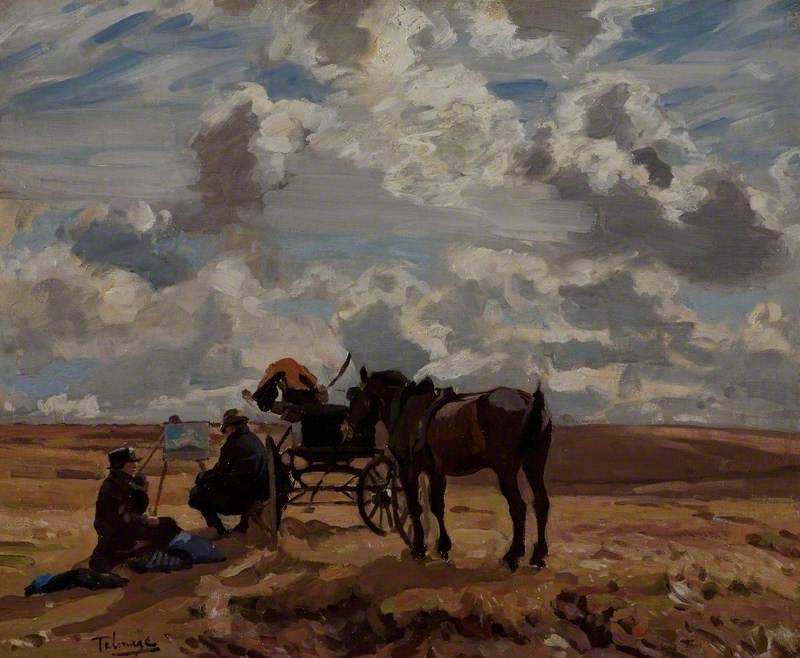
Algernon Talmage was especially interested in painting the elements and specialised in seascapes.
This painting is all well-nigh the atmospheric condition. The sketchers of the title are huddled backside the equus caballus and carriage, adamant to pigment the scene around them as the wind threatens to blow away their fine art materials.
The Sketchers 1930
Algernon Talmage (1871–1939)
Oil on canvas
H l.8 ten W sixty.ane cm
Victoria Art Gallery
1930
© by permission of the copyright holder. Photo credit: Victoria Fine art Gallery
Globe War I to the Present Mean solar day
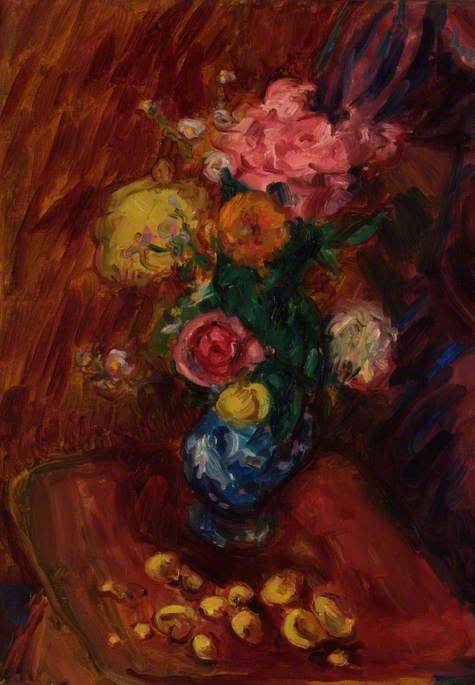
Matthew Smith visited France many times. His painting was inspired by the work of the grouping of French artists known every bit the 'Fauves' or 'wild beasts'. They were given this name past a French art critic in 1905 who was struck past their stiff colours and a assuming way. Our painting is typical of Smith's work. He produced many colourful and exuberant pictures of vases of flowers.
Roses in a Blueish Vase c.1930
Matthew Arnold Bracy Smith (1879–1959)
Oil on canvas
H 60 ten W 45 cm
Victoria Art Gallery
1931
© estate of John David Roberts. By courtesy of The William Roberts Society. Photo credit: Victoria Art Gallery
World War I to the Present Twenty-four hours
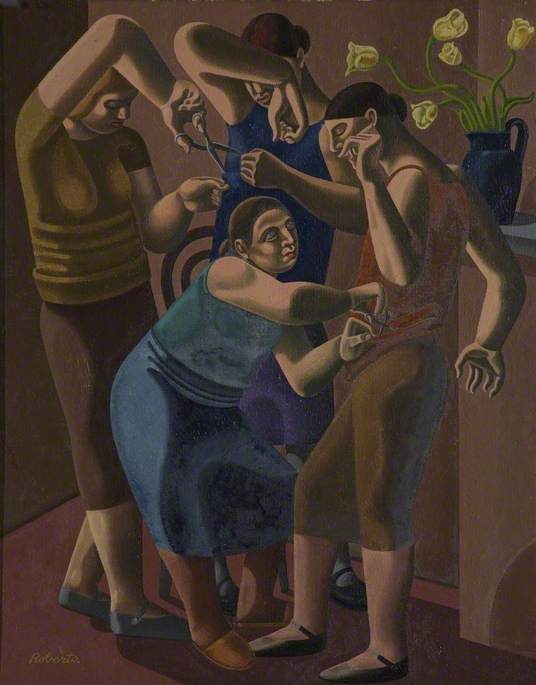
William Roberts was a carpenter's son, built-in in Hackney, who won a scholarship to the Slade School of Art. In the 1910s he and other London-based artists who declared they were producing new fine art for a new century. Their semi-abstruse pictures were inspired by modern mechanism and manufacture.
The Showtime World State of war interrupted their piece of work, and Roberts became an Official War Artist. After the War he developed his own style using clear, tubular forms and strong colours. He painted in the same fashion for the residue of his working life.
The Dressmakers 1931
William Patrick Roberts (1895–1980)
Oil on canvas
H 50.eight 10 Westward 40.6 cm
Victoria Art Gallery
1933
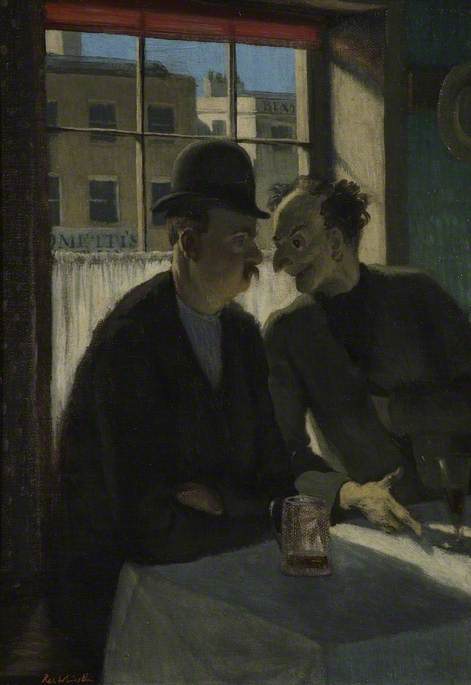
Photo credit: Victoria Art Gallery
World War I to the Present Twenty-four hours
Reginald John 'Rex' Whistler showed precocious creative talent every bit a teenager. He studied first at the Royal Academy but was 'sacked for incompetence'. He then went to the Slade School of art, which he found to be a more congenial environment. Whistler worked in diverse areas of art and blueprint: painting murals, illustrating books and designing theatrical sets, posters and Wedgwood cathay.
Typical of Whistler's oil paintings, The Foreign Bloke is whimsical and enigmatic. Two intriguing men sit by a window, deep in conversation. Which is the 'foreign gars' of the title? Perchance it is the bailiwick of their chat.
The Strange Bloke c.1933
King Whistler (1905–1944)
Oil on lath
H 35.7 x Westward 24.7 cm
Victoria Art Gallery
1941
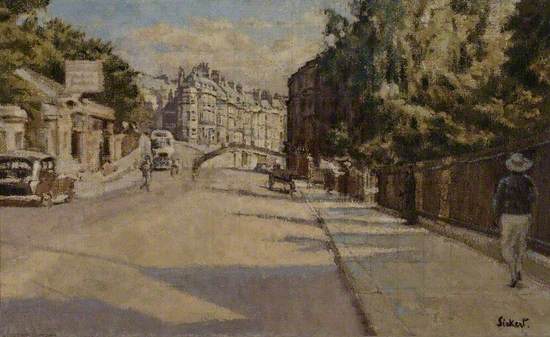
Photo credit: Victoria Art Gallery
Earth War I to the Nowadays Day
Walter Sickert is the most important 20th century artist to have worked in Bathroom. He first came to the city during Earth State of war 1, at a time when he was forced to give up his normal practice of travelling abroad to work. He loved Bath's Georgian architecture and the way the buildings and streets appeared to stretch effortlessly into the surrounding hills.
This view of London Street was based on a photo. The filigree lines that he used to transfer the prototype to the sheet are deliberately left faintly visible, he was known to be attracted to their abstract properites.
London Street, Bathroom c.1941
Walter Richard Sickert (1860–1942)
Oil on sail
H 48.three 10 W 79 cm
Victoria Fine art Gallery
1950
© estate of William Scott 2022. Photo credit: Victoria Fine art Gallery
World War I to the Present Day
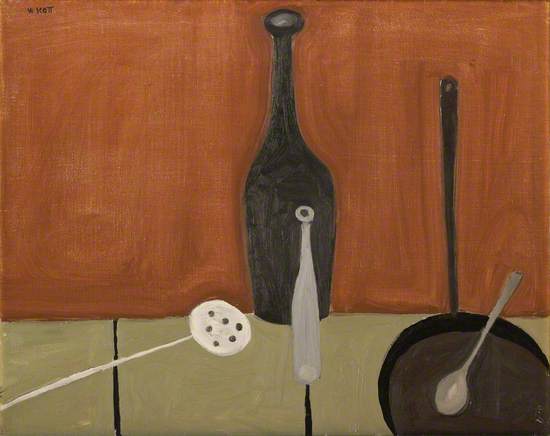
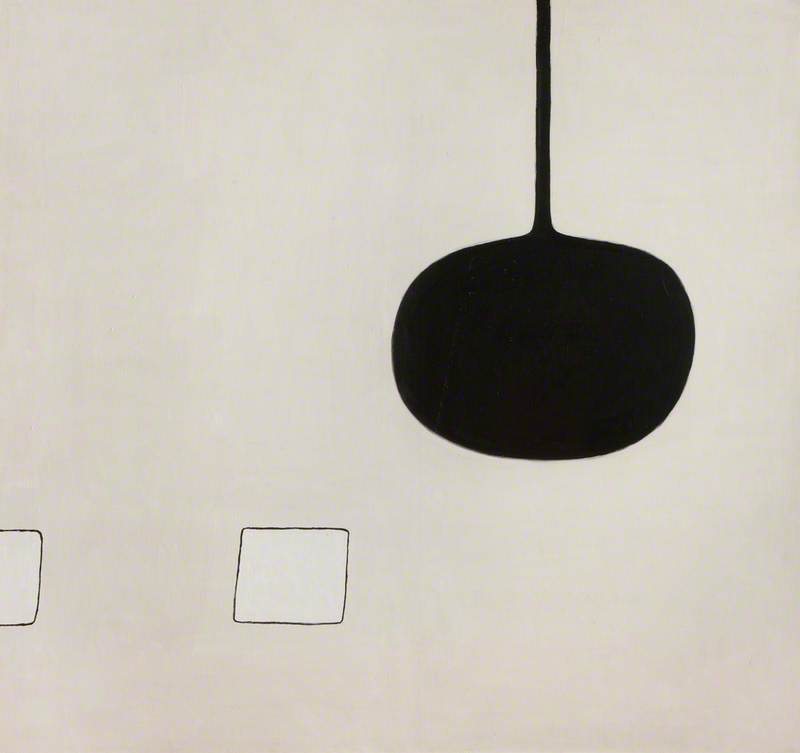
William Scott painted this while working as Senior Painting Master at the Bath Academy of Art at Corsham. Scott was well connected and encouraged many progressive immature artists from London and St Ives to teach at the University. Information technology quickly became a leading fine art school.
Later on leaving the army in 1945, Scott returned to painting full time, acquiring an international reputation in the 1950s and 60s. Scott created many withal lives featuring homely objects such every bit pots, pans and vegetables. In Canteen and Fish Slice the simple objects reflect the artist's working class groundwork and emphasise their abstruse qualities.
Canteen and Fish Piece 1949 or 1950
William Scott (1913–1989)
Oil on canvas
H 40.viii x W 50.8 cm
Victoria Art Gallery
1951
Earth War I to the Present Twenty-four hours
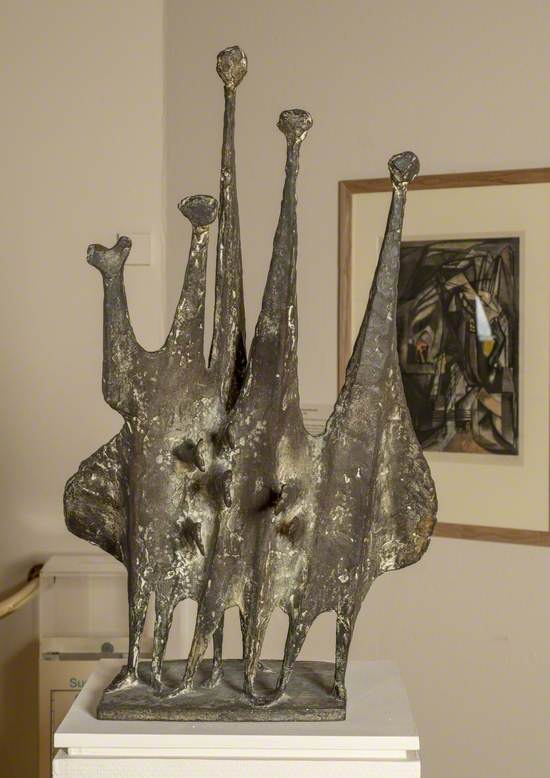
Kenneth Armitage joined the Bath School of Art (later Bath Academy) as Caput of Sculpture in 1946. Soon it relocated to the Wiltshire town of Corsham, where he was based for ten years. Using a tin hut as a studio he produced a series of 'linked-effigy' sculptures out of wire mesh and plaster. Their taut, streamlined shapes reflected his love of engineering structures and modern compages. People in the Air current is also reminiscent of the silhouettes of aircraft; Armitage was a trainer in shipping recognition during World War Two.
This sculpture received international exposure and contributed to Armitage'south meteoric rise to fame.
People in the Wind 1951
Kenneth Armitage (1916–2002)
Bronze
H 65 x Due west 39 x D 32.5 cm
Victoria Art Gallery
1953
© the creative person'south estate. Photo credit: Victoria Fine art Gallery
World War I to the Nowadays Mean solar day
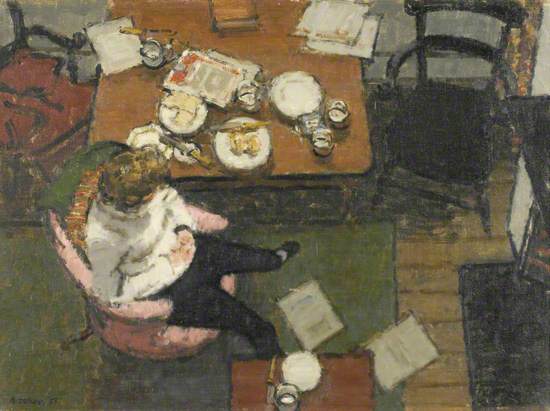
The Pink Chair 1953
William Brooker (1918–1983)
Oil on canvas
Victoria Art Gallery
1958
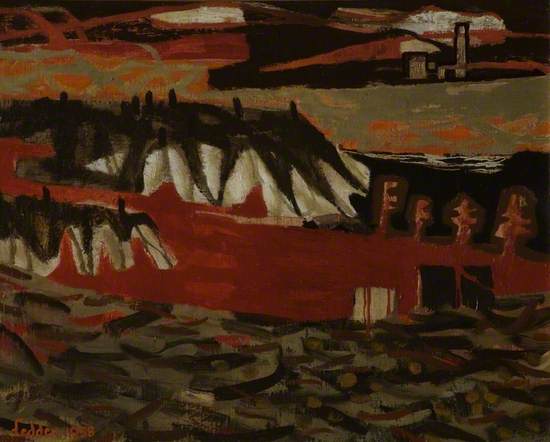
Earth War I to the Present Day
Mary Fedden was born in Bristol and achieved national success early in life. After studying at the Slade School of Fine art she became known for her mural paintings, such as those for the 1951 Festival of Uk, the P&O liner Canberra and Charing Cross Hospital.
1958, the year in which Fedden painted this picture, was something of a turning signal in her career, equally she was appointed the first woman tutor at the Royal College of Art.
Albi is a boondocks in southern France. It is virtually fifty miles from Toulouse.
Near Albi, France 1958
Mary Fedden (1915–2012)
Oil on sheet
H 45 x W 51 cm
Victoria Art Gallery
1960
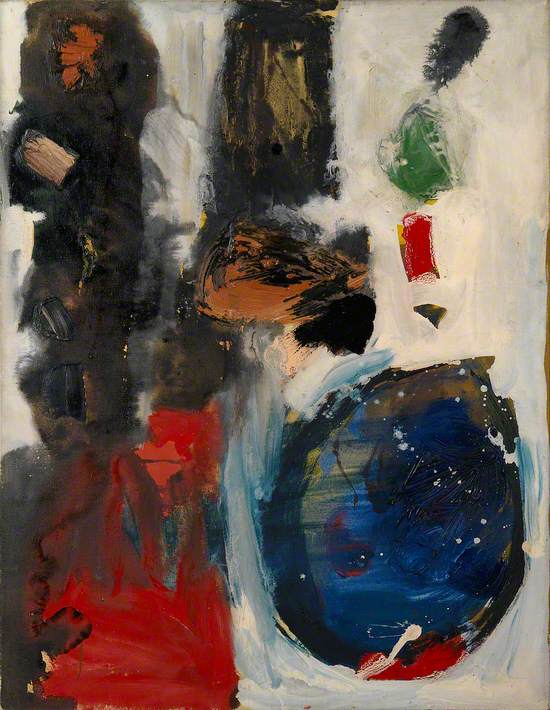
© the artist's estate. Photo credit: Victoria Art Gallery
Globe State of war I to the Present Mean solar day
Like many other artists represented here, Gillian Ayres was on the staff of the Bath University of Fine art. Ayres' arroyo was non to teach according to gear up formulae. Instead she adult a more student-orientated style, a epitome for the tutorial system even so in employ today, whereby students are encouraged to follow their ain lines of artistic investigation.
Sunday Upwardly dates from her period at the Academy. She has combined vigorous brushwork and the throwing of paint at the canvas with the complimentary use of turpentine as a colour thinner, assuasive the paint to stain, dribble and splatter. The result is to convey a sense of solar day chasing nighttime, shape and colour supplanting darkness and obscurity.
Lord's day Upwards 1960
Gillian Ayres (1930–2018)
Oil on canvas
Victoria Art Gallery
1981
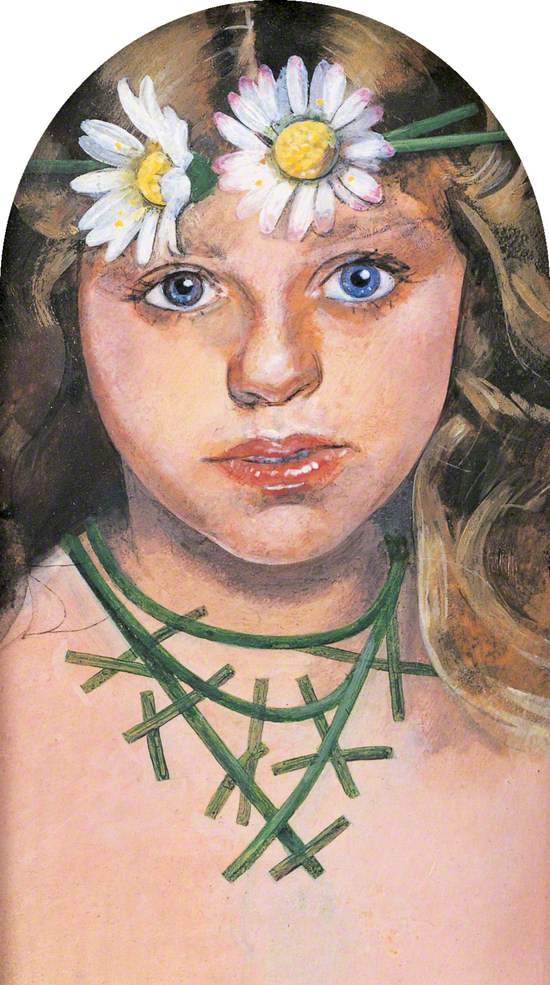
© Peter Blake. All rights reserved, DACS 2022. Photo credit: Victoria Art Gallery
World War I to the Present Mean solar day
During the 1960s Peter Blake became 1 of the well-nigh successful figures in British fine art with his iconic cover for The Beatles' album 'Sergeant Pepper's Lonely Hearts Club Band'. In 1969 he moved to Wellow, well-nigh Bath. Together with other artists who had made like transitions to the countryside, Blake gear up the 'Alliance of Ruralists' in 1975. It was an informal group whose stated aims were 'to paint about beloved, beauty, joy, sentiment and magic', aims perfectly represented by this trivial painting.
Daisy Fairy 1981–1982
Peter Blake (b.1932)
Oil on hardboard
H 28 x W xvi.5 cm
Victoria Fine art Gallery
1992
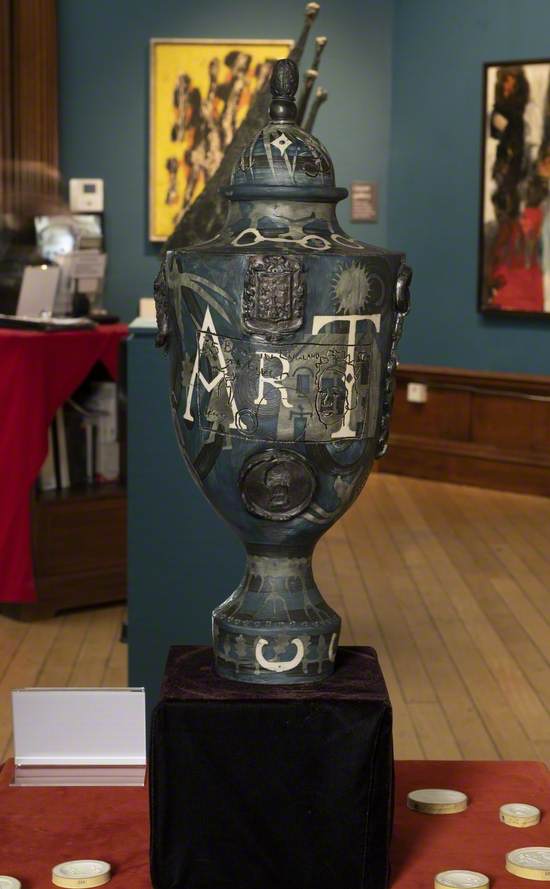
© Grayson Perry, courtesy of Victoria Miro Gallery. Photo credit: Victoria Art Gallery
World War I to the Present Solar day
This piece of work is nigh taste and identity. The form is based on aboriginal Greek urns. Classical pottery and sculpture has a long history of being associated with good gustation and high status. Posh Art is designed to encourage us to think about what belongs in art galleries, and why.
Posh Art 1992
Grayson Perry (b.1960)
Ceramic
H 43 x W 18 ten D 18 cm
Victoria Art Gallery
1997
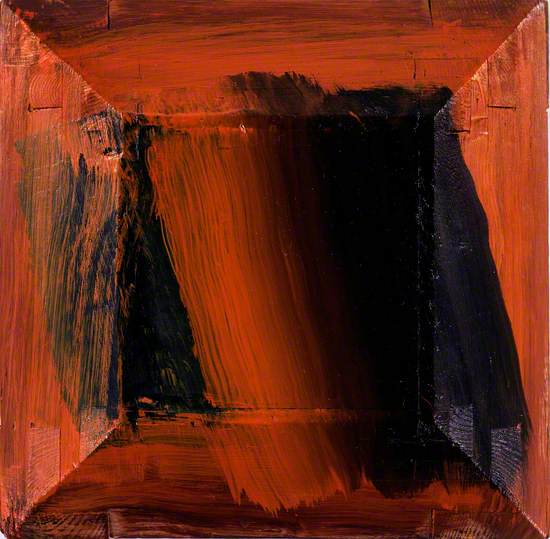
© Howard Hodgkin. All rights reserved, DACS 2022. Photo credit: Victoria Art Gallery
World State of war I to the Present Solar day
Howard Hodgkin studied at the Camberwell School of Art and the Bathroom Academy of Art earlier going on to teach at the latter from 1955 to 1966.
Hodgkin'southward paint surfaces are congenital upward in layers over years and will often be completely reworked more one time before the finished slice is released from the studio.
It is rare for Hodgkin to talk about the inspiration for his work, preferring the viewer to weave their own stories around his allusive paintings. The title is the simply clue we are given.
Silence, similar all Hodgkin'southward paintings, was painted on a piece of recycled wood, in this instance the back of a 17th century Dutch frame.
Silence 1997 & 2004
Howard Hodgkin (1932–2017)
Oil on wood
Victoria Art Gallery
1999
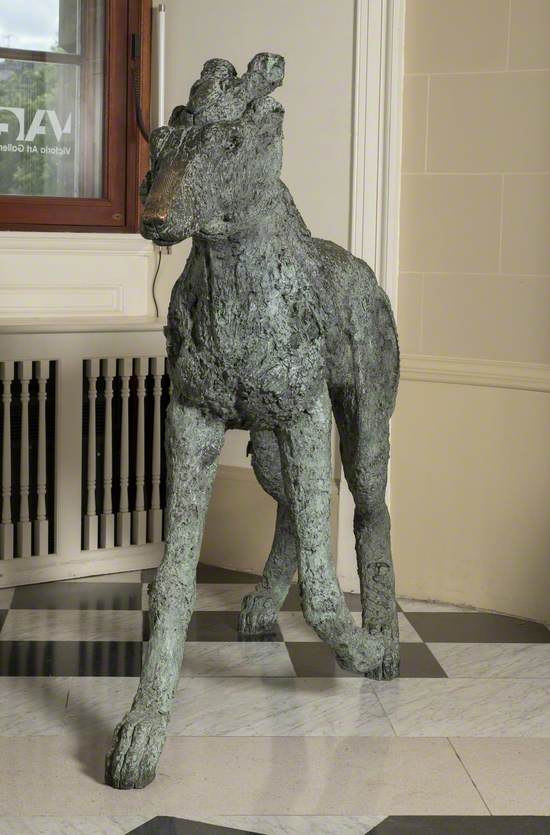
© the artist. Photo credit: Victoria Art Gallery
World State of war I to the Nowadays Twenty-four hour period
Lady-Hare on Dog 1999
Sophie Ryder (b.1963)
Bronze
H 145 ten West 168 10 D 52 cm
Victoria Art Gallery
2010
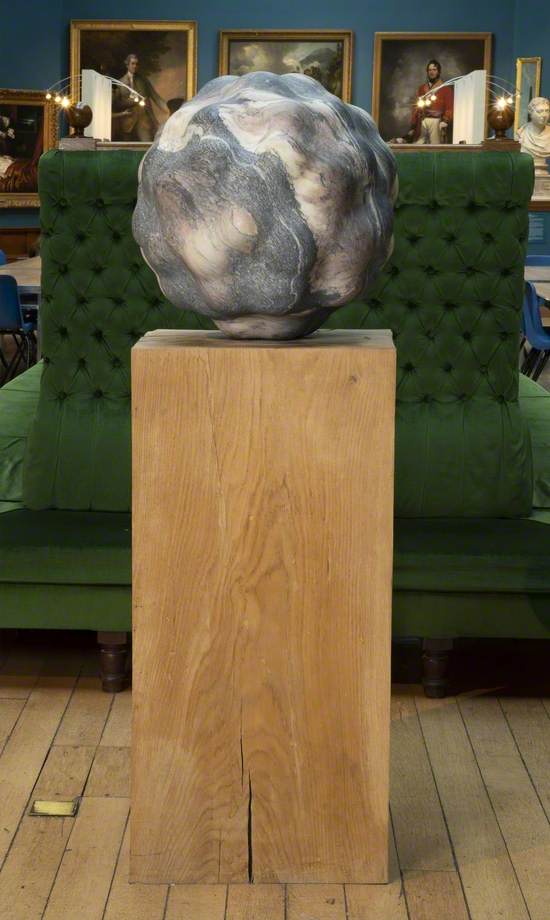
© the artist. Photo credit: Victoria Art Gallery
World War I to the Present Day
Solid Air Three 2010
Peter Randall-Folio (b.1954)
Marble
H 49 x Westward fifty x D 49 cm
Victoria Fine art Gallery
Explore artists in this Curation
View all 79
-
Adriaen de Bie (1593–1668)
-
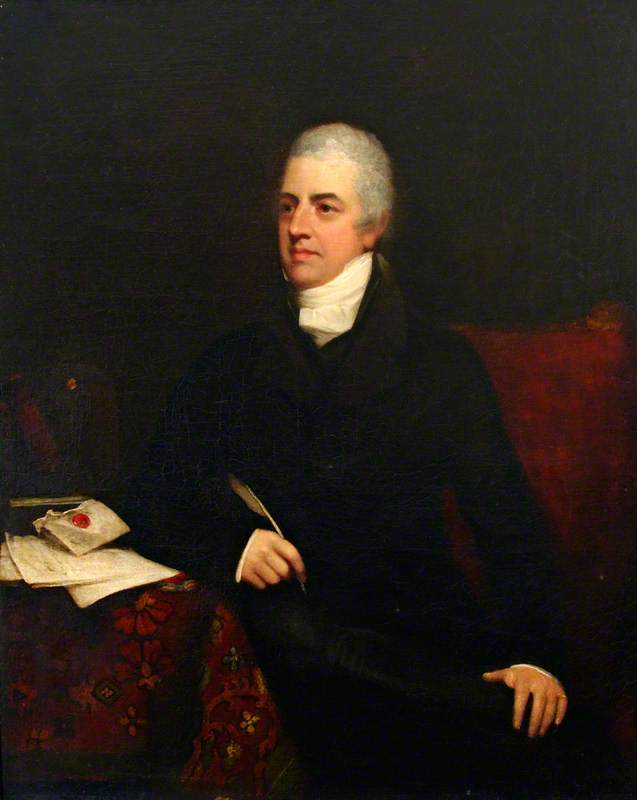
James Green (1771–1834)
-
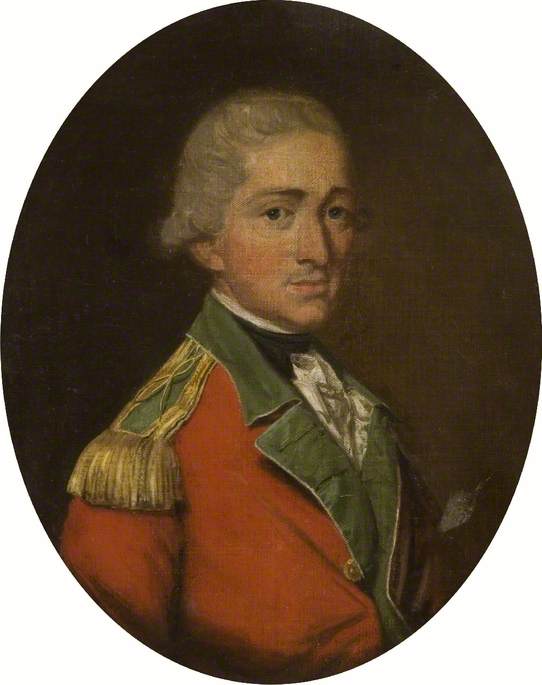
Thomas Beach (1738–1806)
-
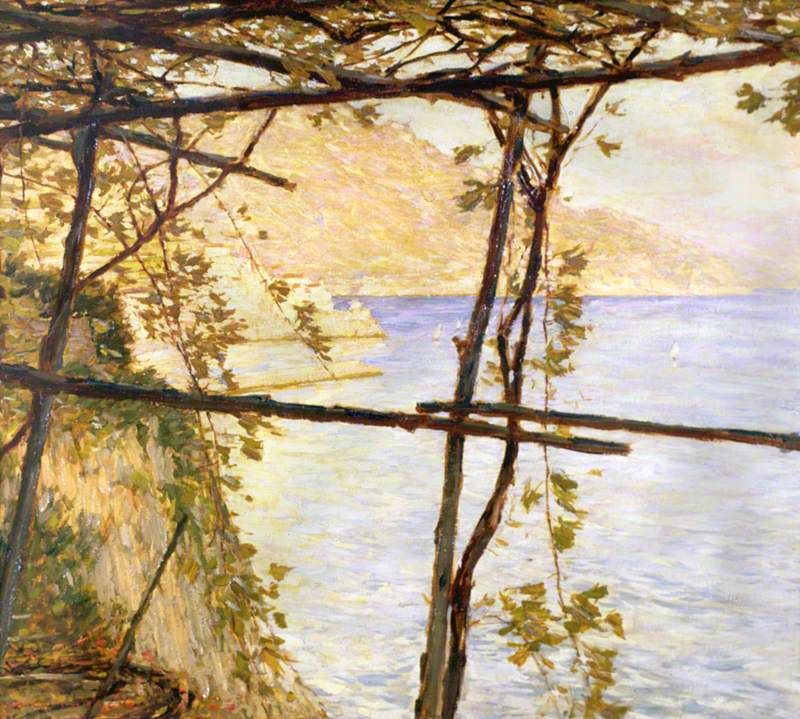
Henry Herbert La Thangue (1859–1929)
-
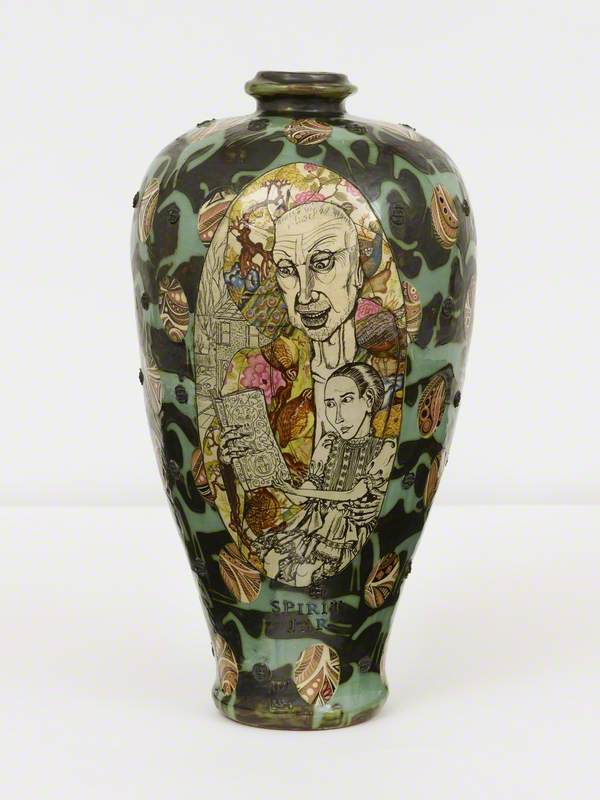
Grayson Perry (b.1960)
-
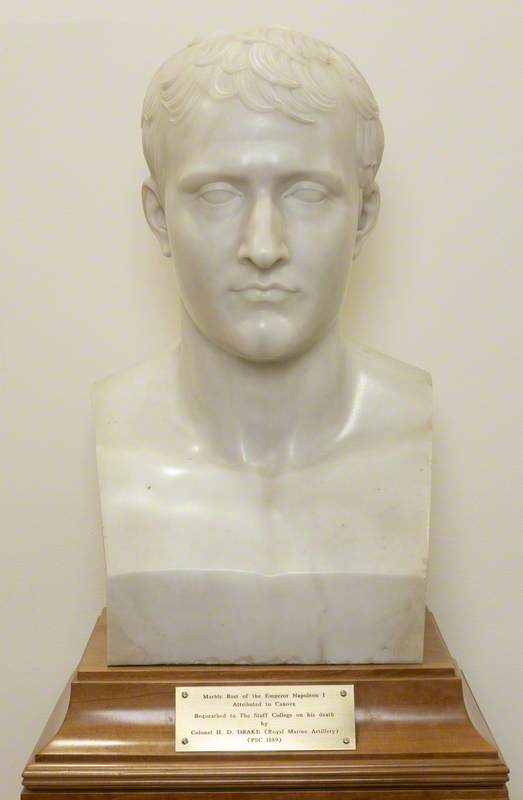
Antonio Canova (1757–1822)
-
Algernon Talmage (1871–1939)
-
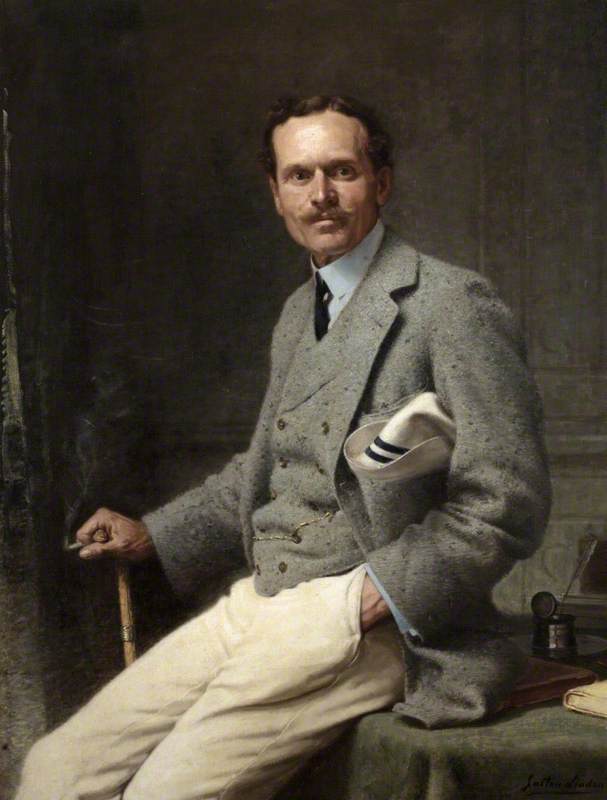
Gaston Linden
-
William Scott (1913–1989)
-
Jan Brueghel the elder (1568–1625)
- View all 79
Source: https://artuk.org/discover/curations/upper-gallery-display
0 Response to "The Victoria Art Gallery Bath Detail of Smugglers Landing by Jaques De Loutherbourg"
Post a Comment