Three Principles of Art Found in the Abu Simbel
Exploring Abu Simbel: A Visitor'south Guide
We may earn a commission from affiliate links ()
The near magnificent of the monuments Ramses II built, Abu Simbel is both the perfect example of the appetite of this pharaoh'south reign and also a model illustration of the achievements of modern technology and global cooperation.
The entire temple complex was transplanted from its original location and lifted piece by piece to its current site past an international UNESCO team working against the clock to preserve it from beingness flooded by the Aswan High Dam in the 1960s.
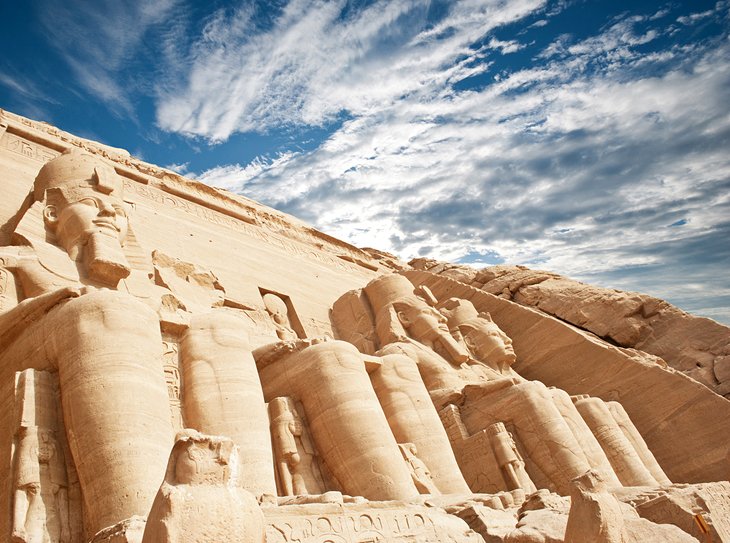
The colossal stone statues that grace the facade are Pharaoh Ramses II'southward attempt to achieve immortality. It has worked. Today, visitors here still crane their necks in disbelief at the behemoth temples just equally the pharaoh's subjects would have washed when the temples were offset raised.
Abu Simbel is 280 kilometers southward of Aswan. Most people visit on a solar day trip from Aswan, although it is possible to stay the night in Abu Simbel village.
Our visitor'south guide to exploring Abu Simbel will assist you plan your time among these famed monuments of Ramses II'south reign.
Notation: Some businesses may be temporarily closed due to recent global health and safety issues.
On This Page:
- Temple of Ramses II
- History of Abu Simbel: Ramses II's Bang-up Piece of Propaganda
- Effectually the Keen Temple of Ramses 2
- Getting to Abu Simbel
Temple of Ramses II
Forecourt & Terrace: The Principal Courtyard
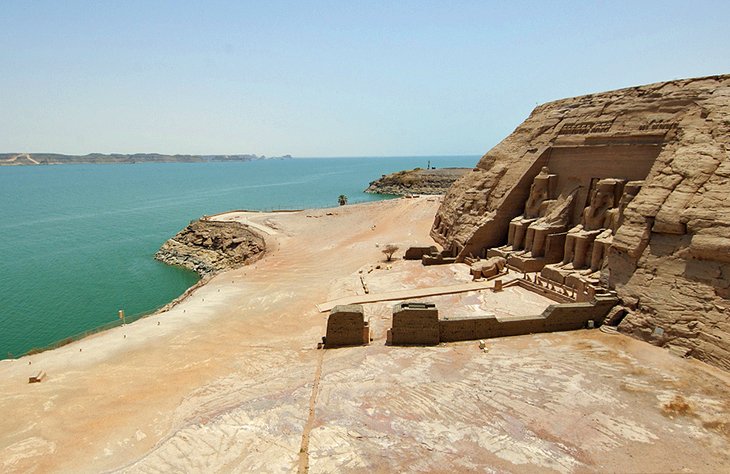
Although today, the entire Forecourt in front of the temple is open, originally it would have been enclosed on the north and south by brick walls, while the e side of the court would have been open, looking on to the Nile.
From the Forecourt, a flying of steps leads you up to the Terrace in front of the temple.
If you look to the correct and left, just before the ramp, you'll run across two recesses, which probably contained basins for ritual ablutions. In the recesses are stelae depicting Ramses II making offerings.
Along the front of the Terrace is a decorative frieze portraying representatives of many different people making obeisance to the pharaoh.
In front of the balustrade, which has a dedicatory inscription running along its unabridged length, are figures of falcons alternating with small statues of Ramses 2. The figures at the south finish of the balustrade were probably destroyed by the collapse of the upper part of the 2d of the colossi figures.
Colossi of Ramses II: The Guards of the Inner Temple
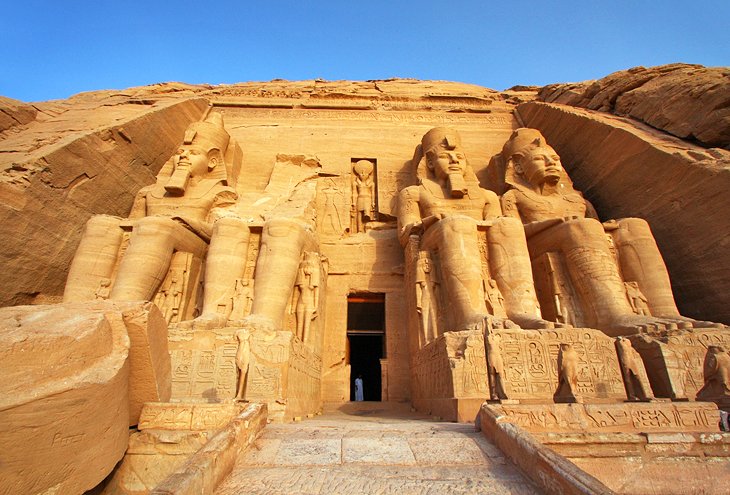
4 colossal figures hewn from solid rock guard the massive 33-meter-high facade of the temple.
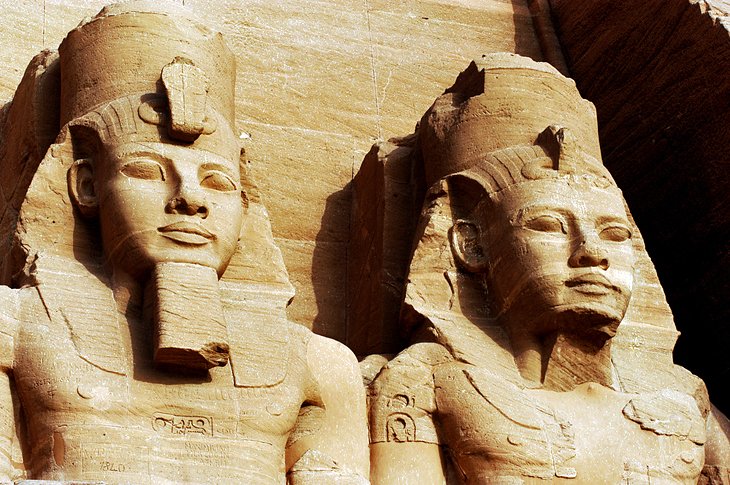
Seated on thrones, these 20-meter-high Colossi of finely carved features and stylized harmony represent a deified Ramses Two.
The two on the left draw the pharaoh every bit Heka-tawi and Re-en-hekaw.
The ii to the correct of the doorway show Ramses II as Meri-Amun and Meri-Atum.
The pharaoh's balmy eyebrow and feature nose are best preserved in the first of the Colossi (at the far left).
The second figure lost its head and shoulders in ancient times, possibly as a outcome of a rock fall or an earthquake (or a combination of both), and these now lie on the footing in front of it.
The Ramses figures article of clothing the double crown of Egypt and are represented with the formal spade-like beard. On his breast and upper arms and between his legs, y'all can encounter royal cartouches.
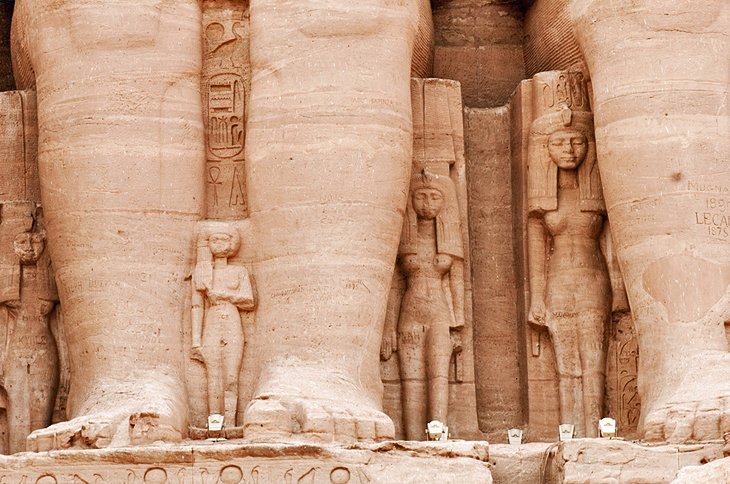
To the correct and left of each statue and between their legs are figures on a smaller scale only however larger-than-life size, representing members of the royal family.
Flanking the outset colossus is the Princesses Nebt-tawi (left) and Bent-anat (correct), with an unnamed Princess between the legs, and flanking the second colossus is the pharaoh's mother, Tue (left), and his married woman Queen Nefertari (right), with Prince Amen-herkhopshef between the legs.
On the inner sides of the thrones of the two central Colossi, flanking the entrance to the temple, are figures of the 2 Nile gods wreathing the floral emblems of Upper and Lower Egypt, the papyrus and the lotus, around the hieroglyphic sign significant "unite," while below are rows of Kushite and Syrian prisoners.
On the two southern Colossi, yous can encounter Greek, Carian, and Phoenician inscriptions carved past mercenaries who had passed this way on various military expeditions.
Hypostyle Hall: The Inner Temple
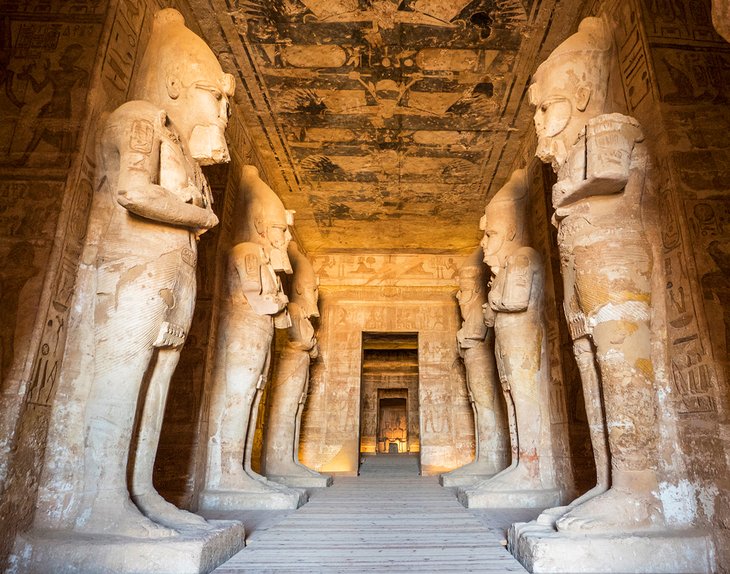
The grand entrance leads you into the huge 17.7-meter-long Hypostyle Hall.
It is divided into 3 aisles (the key one being twice the width of the other ii) past two rows of iv foursquare pillars, and on the inner sides are 10-meter-loftier Osiris figures of the pharaoh holding the scourge and the cheat.
The figures on the right hand side article of clothing the double crown of Upper and Lower Egypt, while those on the left article of clothing the crown of Upper Arab republic of egypt. The stylized symmetry of these massive figures is striking.
The ceiling of the primal aisle has paintings of flying vultures; those of the lateral aisles are adorned with stars.
To the correct and left of the Hypostyle Hall are eight small side chambers, some of which served as treasuries and store rooms. Their decoration is of varying quality, but in general is simpler than that of the main chambers of the temple. Some of the rooms take rock tables along the walls.
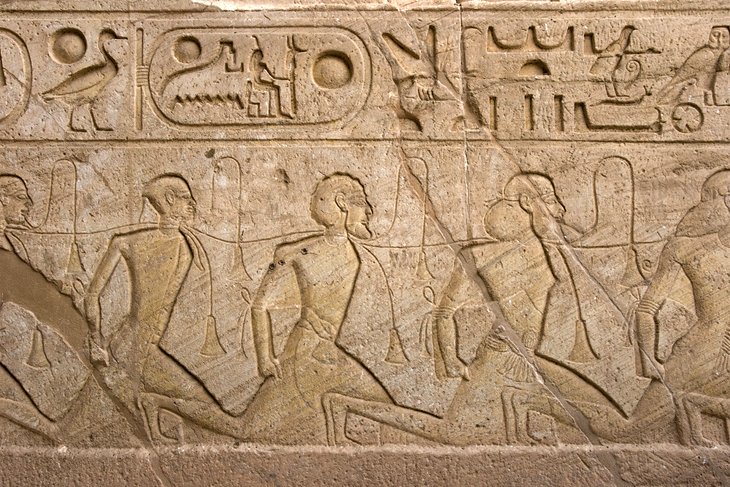
Don't Miss: Abu Simbel is most famous for the fabulous landscape reliefs in the Hypostyle Hall depicting the pharaoh's entrada confronting the Hittites in the Battle of Qadesh (reliefs of the battle can besides be seen in Luxor's Ramesseum and in the Temples of Abydos).
The Battle of Qadesh scenes take over the Hypostyle Hall's northern wall.
In the lower register, at the left hand end, the Egyptian army is depicted on the march. The various activities in the campsite are portrayed in a lively way - the horses being given their fodder, and the troops resting after their march.
The third scene shows Ramses II property a Council of War, while below, two enemy spies are being beaten. The last scene depicts the battle between Egyptian and Hittite charioteers.
The scenes in the upper register accept us into the thick of the battle.
To the left, the pharaoh is shown dashing against his enemies, who have surrounded him with their chariots.
In the eye is the enemy stronghold of Qadesh, encircled by the River Orontes, with the defenders looking downwards from the battlements. To the correct, Ramses II in his chariot watches while his officers count the severed hands and limbs of the enemy and bring in prisoners.
In the correct-hand half of the rear wall, the pharaoh is shown leading two files of Hittite prisoners into the presence of Re-Harakhty, his own deified effigy, and the lion-headed Wert-hekaw. In the left paw one-half, he presents Kushite prisoners to Amun, the deified Ramses and Mut.
Vestibule
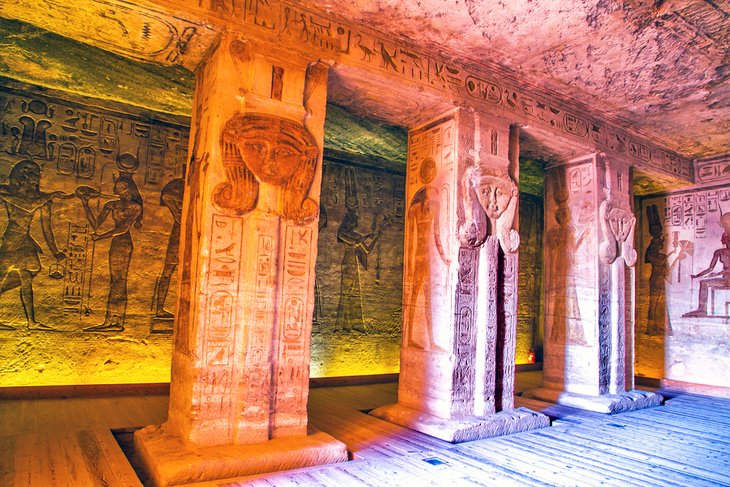
Beyond the Hypostyle Hall, yous come to the Vestibule, which is divided into three aisles by four square pillars. On the sides of the pillars are representations of Ramses 2 being received into the company of the gods.
Don't Miss: Look up at the south wall to see the barque of Amun-Re. The barques are borne in procession, preceded past the pharaoh and his wife Nefertari making offerings of food and incense.
Transverse Sleeping accommodation
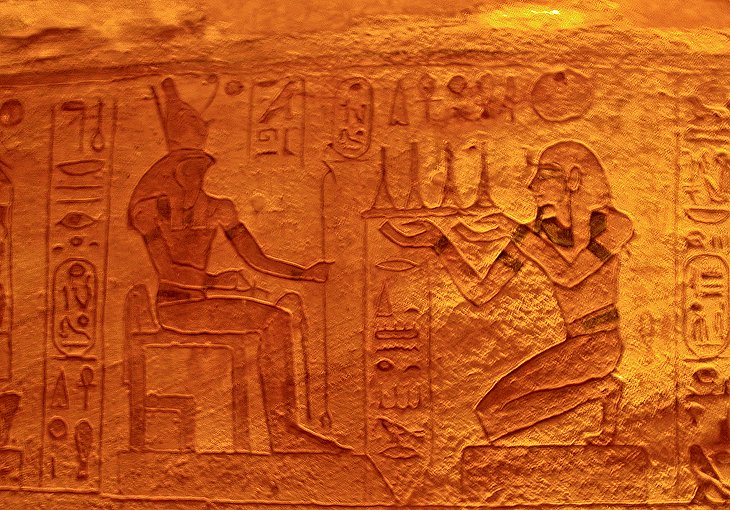
From the Vestibule, three doorways lead into a long and narrow Transverse Sleeping accommodation.
On the walls of this chamber, Ramses Ii is shown making offerings to Min, Horus, and Khnum (left-hand terminate) and to Atum, Thoth, and Ptah (correct-mitt cease) who were besides worshiped here, almost with the status of guest divinities.
The Sanctuary: Business firm of the Gods
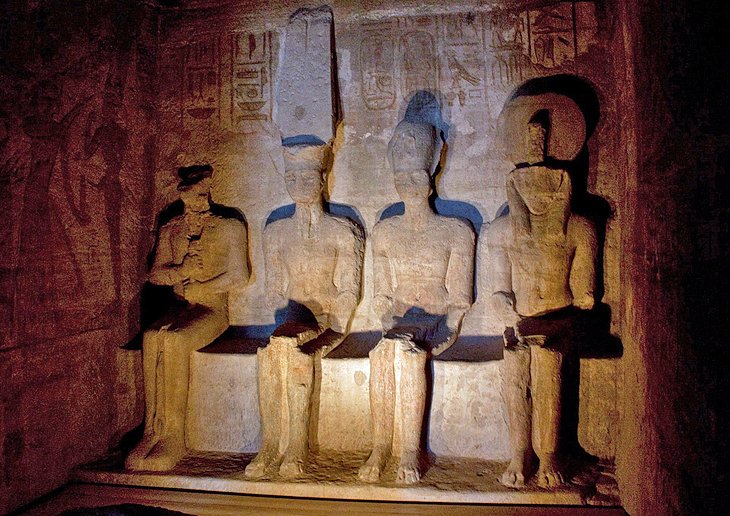
From the Transverse Chamber, three doors lead into three pocket-size rooms at the farthest finish of the temple.
In the center is the rectangular Sanctuary, which could be entered only by the male monarch.
Don't Miss: On the right-hand and left-hand walls, Ramses II is depicted called-for incense.
On the rear wall are larger-than-life-size figures of Ptah, Amun-Re, the pharaoh himself, and Re-Harakhty (from left to right), once again giving expression to Ramses 2's complete equality with the gods.
In forepart of the figures is the square base, hewn from the rock, of the sacred barque, which was kept here.
History of Abu Simbel: Ramses II'south Great Piece of Propaganda
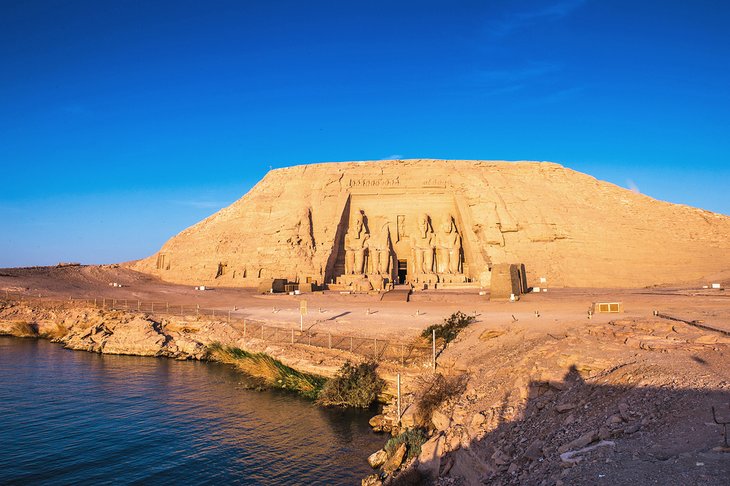
Archaeologists tin just speculate why Ramses II decided to construct such magnificent temples on this particular site.
Probably there were already cave sanctuaries here from a very early menses, since such sanctuaries were numerous in Nubia.
With the creation of a temple defended to himself, Ramses II became the first pharaoh to accept the final decisive step towards equating rex and god, and at the same time, the structure of the temples symbolized his royal and divine claim to rule the golden and copper rich region of Nubia.
In the course of millennia, many armies, merchants, caravans, and other travelers passed this way, frequently leaving inscriptions and graffiti, which throw light on the circumstances of the menstruation.
Traces of soot inside the temples show that they were sometimes used as dwellings. Later, both temples were buried under the desert sand and sank into an oblivion, which lasted until the early years of the 19th century.
On March 22, 1813, the Swiss traveler Johann Ludwig Burckhardt (1784-1817) discovered the heads of the colossal figures of Ramses II emerging from the drifts of sand, just was unable to establish what they were or to penetrate into the interior of the temple.
The systematic excavation of the temples was begun by Burckhardt's friend and beau explorer, the Italian Giovanni Belzoni (1778-1823), in 1817. From this time, the temples became Upper Arab republic of egypt's nearly famous treasure.
New dangers threatened the Abu Simbel temples when work began on the structure of the Aswan Loftier Dam on January nine, 1960, since the temple site would be swallowed up by the ascension waters of Lake Nasser.
At the joint request of Egypt and Sudan, UNESCO rallied together a massive rescue functioning, which saved the temple circuitous for posterity.
There was much give-and-take of possible means of saving the temples.
Amidst the projects considered were plans for floating both temples on pontoons, which as the lake rose would acquit them upwards to a new site on college ground, and more fanciful proposals for enclosing the whole site inside a spherical crush or glass aquarium into which visitors would descend in lifts below Lake Nasser'southward waters to visit.
Most of the plans put forward were rejected on either technical or aesthetic grounds, and the only proposal that seemed acceptable in this initial planning phase was a French i. This involved cut both temples out of the solid rock in their entirety, setting them on huge slabs of concrete, and then raising them to a new site by the use of hydraulic jacks.
To raise the larger temple, weighing 265,000 tons, 440 jacks would accept been required; for the smaller temple, weighing 55,000 tons, 94 jacks were needed. But this projection, too - comparable in its disrespect with the original construction of the temples - had to exist abandoned on account of the gigantic cost.
Finally, as the level of the lake continued to rising, and time grew always shorter, the conclusion was taken to adopt a proposal put forrad past the Egyptian sculptor Ahmad Osman for sawing the temples into manageable blocks and re-erecting them on higher footing virtually their original sites.
When work began in the leap of 1964, the water level of Lake Nasser was already then loftier that the temples had to be protected by a cofferdam. They were then sawn upwardly into blocks of a maximum weight of twenty tons (807 blocks for the larger temple, 235 for the smaller), the cutting lines being so arranged that the joins would be as camouflaged equally possible when the temples were re-erected.
The blocks were so stored until the new site (65 meters higher and 180 meters further northwest) was ready to receive them.
The interior walls and ceilings of the temples were suspended from a supporting framework of reinforced physical, which provided increased stability. The loss of stone resulting from the sawing process was remedied by a mortar of cement and desert sand.
The re-erected temples were roofed over by massive reinforced concrete domes with spans of 50 meters and 24 meters and internal heights of 19 meters and seven meters respectively, which provided support for the mass of rubble and rock covering the whole structure.
Past the summer of 1968, the work was completed, and a cultural monument of outstanding importance had been preserved for time to come generations.
Around the Not bad Temple of Ramses II
Temple of Hathor
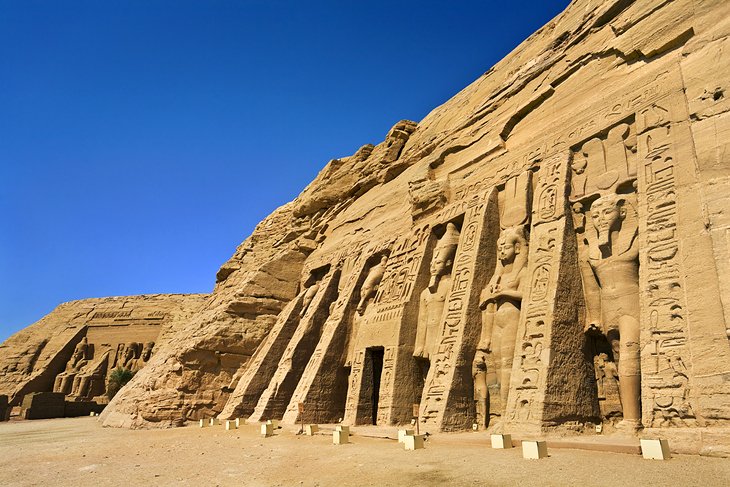
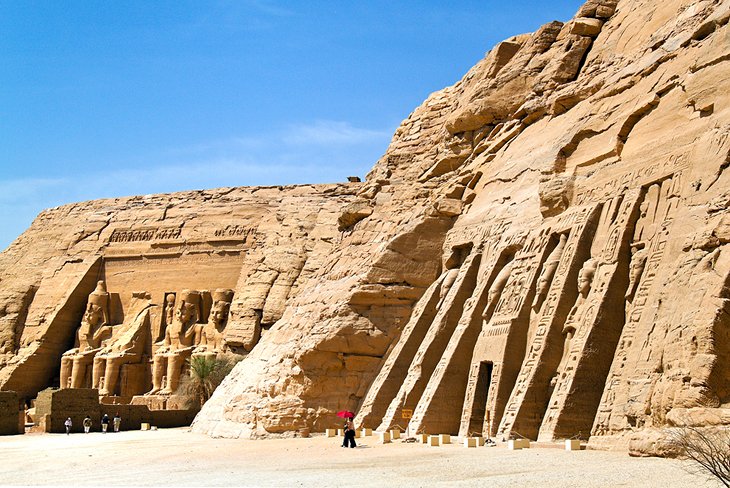
To the north of the Swell Temple of Ramses II is the Temple of Hathor (besides known as the Minor Temple of Abu Simbel).
It was originally situated on a rocky promontory reaching out towards the Nile and separated from the Nifty Temple by a sand-filled valley.
The temple was dedicated to Hathor, goddess of dear, and to the deified Nefertari, Ramses' married woman. During the Nile flood, information technology could be reached direct from the river past way of a quay of which no trace survives.
The 12-meter-high facade is hewn from the rock in imitation of a pylon with a cavetto cornice (now missing).
In the rock face, the Royal Steward and Scribe Iuni of Heracleopolis, who was probably in charge of the construction of the Abu Simbel temples, had himself represented in the human activity of demonstrating his devotion to his royal and divine master.
Colossi
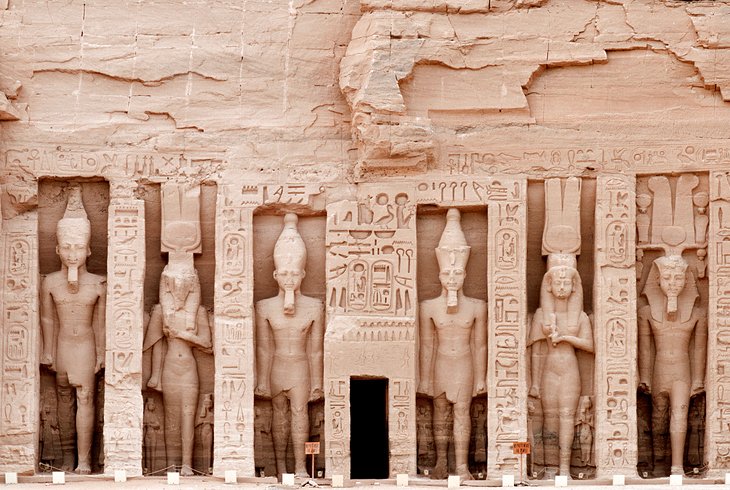
Six jumbo ten-meter-loftier statues dominate the entrance facade depicting Ramses Two and Queen Nefertari. Unusually, the queen is the same size as the pharaoh.
Flanking the statues are smaller figures of the royal children, the princesses (depicted with their left foot advanced in front end of them) existence larger than the Princes.
Beside the figure of Nefertari are the Princesses Merit-Amun (right) and Hent-tawi (left). Beside the figures of Ramses 2 at each cease of the facade are the Princes Meri-Atum (correct) and Meri-Re (left), and abreast the key figures of the pharaoh are Amen-her-khopshef (right) and Re-her-unemef (left).
Between the figures are projecting sections of rock-like buttresses, so that the statues appear to be set in niches. In view of the extreme friability of the rock, the whole area of the facade was plastered and painted. All the buttresses are covered with hieroglyphic inscriptions.
Hypostyle Hall
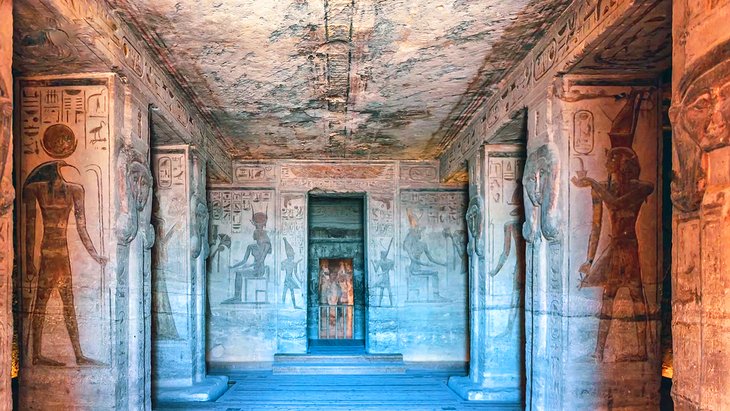
The entrance leads into an almost square Hypostyle Hall, divided into three aisles by six pillars, on the fronts of which are sistra with the caput of the cow-eared goddess Hathor. On the other sides of the pillars are figures of the royal couple and various deities.
Don't Miss: The landscape reliefs are simpler and less colorful than those in the Smashing Temple, simply are also of great creative and historical value.
Await up at the entrance wall to come across the pharaoh, accompanied past the queen, smiting a Libyan in the presence of Re-Harakhty and a Kushite in the presence of Amun-Re.
Transverse Chamber
From the Hypostyle Hall, iii doorways lead into a narrow Transverse Bedroom.
To the left and correct are ii unfinished side chambers, and over their doors are fine reliefs of the Hathor moo-cow in a papyrus marsh, worshiped respectively by the pharaoh and queen.
Sanctuary
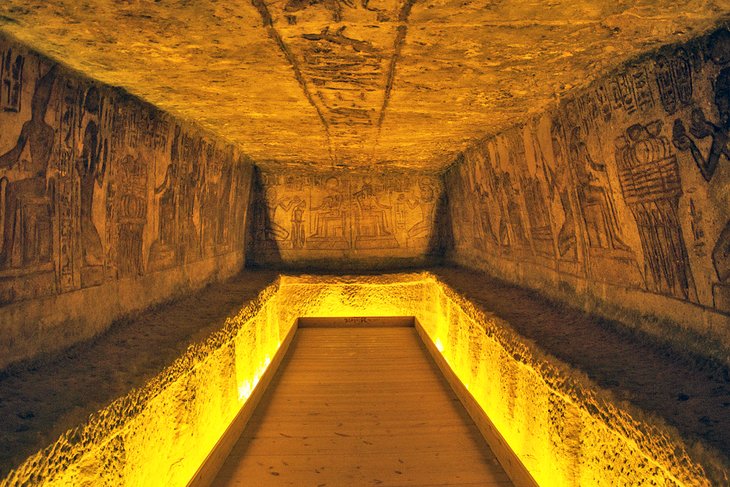
Across the Transverse Chamber is the Sanctuary with a recess in its rear wall in the grade of a chapel, its roof supported by sistra.
In this recess is a effigy in high relief of the goddess Hathor every bit a cow; nether her head (and thus nether her protection) is Ramses 2.
On the left-hand wall the queen offers incense to Mut and Hathor; on the correct-hand wall the pharaoh offers incense and pours a libation in front of his ain image and that of the queen.
Tips and Tours: How to Make the Most of Your Visit to Abu Simbel
Private Tours:
- The Individual Mean solar day Tour to Abu Simbel Temples from Aswan includes comfortable air-conditioned send for the three-60 minutes bulldoze, a qualified Egyptologist as your guide for the day, site entrance tickets, and an in-depth tour of around iii hours at the site, plus lunch. Even ameliorate, the tour is timed for Aswan hotel pickup at 8am, which means you'll become to the site after the vast corporeality of bout groups have left.
- Abu Simbel Bout Inclusions on a Nile Prowl: Many Nile prowl trips between Luxor and Aswan offering an Abu Simbel trip either every bit an included or additional activity for passengers. This upkeep-orientated 4 Day Nile Prowl bundle includes a one-half-24-hour interval trip to Abu Simbel in its itinerary while docked at Aswan.
Tips for Visiting:
- Best Time to Visit: The coach tours from Aswan fill upwards the site from around 7am to 11am. If you want to wander around Abu Simbel devoid of crowds, visit in the belatedly afternoon when the sinking lord's day brushes the exterior stonework in golden hues.
- Staying the Dark: The best choice if you want to make the most of your time at this pop tourist attraction is to stay the night. Abu Simbel village (beside the temples) has a handful of small mid-range and budget hotels and 1 resort where travelers who don't want to rush their temple-viewing time can bed downwardly for the nighttime.
- Audio & Light Bear witness: Abu Simbel'southward nightly sound and lite show is an opportunity to come across the temples under a dazzling array of lights.
- Abu Simbel Sunday Festival: Every year on February 21 and Oct 21 the rays of the ascension sun penetrate into the Neat Temple's Sanctuary, illuminating the faces of the divine figures. This miracle originally occurred one day earlier and is thought to have historic Ramses II'southward altogether and coronation day, which were undoubtedly an occasion for ritual anniversary during the aboriginal Egyptian age. When the temples were moved to their present site a slight displacement of the principal axis was discovered, which ways the phenomenon occurs one solar day later. Today, visitors still flock to Abu Simbel to see this impressive spectacle.
Getting to Abu Simbel
- By Tour Motorcoach: Abu Simbel 24-hour interval trips are hands bundled in Aswan and are i of the easiest options if you're short on time. Unfortunately, it'due south usually a hideously early first in the morning time (a lay-over from the days when buses all had to travel by convoy between Aswan and Abu Simbel). The starting out time is ordinarily betwixt 4am and 5am. Many tours as well include stops at Philae Temple and the Aswan Loftier Dam, and so it's a good fashion to cram plenty of sightseeing into 1 mean solar day.
- By Private Taxi: Trips to Abu Simbel by private taxi are easily arranged in Aswan. They're best booked through your hotel or a local travel agent, as only taxi drivers with a let to travel to Abu Simbel are allowed to take y'all. Traveling this mode ways you lot tin set off at your own designated time to see the temples and miss some of the crowds.
- By Airplane: EgyptAir run an Aswan-Abu Simbel service, which is the quickest way to get hither. Services can exist irregular (and are sometimes canceled for months at a time) though, due to tourist demand. The flight, when running, only takes xx minutes. There are also flights direct from Cairo.
- Past Public Double-decker: Despite what near every travel agent and hotel in Aswan will tell you, at that place is a public passenger vehicle to Abu Simbel. Buses leave once daily from Aswan motorbus station, and the journey takes four hours. This is a skilful option if you're on a budget and want to stay the nighttime in Abu Simbel.
- By Lake Nasser Cruise Gunkhole: A couple of specialized companies run cruises on Lake Nasser that non only visit Abu Simbel, but the many other temples along the lake'southward banks.
More Related Articles on PlanetWare.com
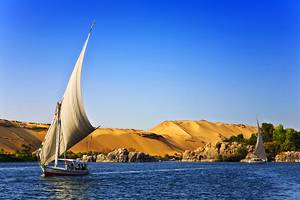 The Aswan Area: Abu Simbel may be the key sight but there's enough else to do if you're in Aswan for a few days. Check out our articles on Aswan, the magnificent Philae Temple, and Edfu'due south Temple of Horus for some ideas. If you're taking the train north after your Aswan trip, have a expect at our articles on Kom Ombo, Luxor, Cairo, and Alexandria for inspiration.
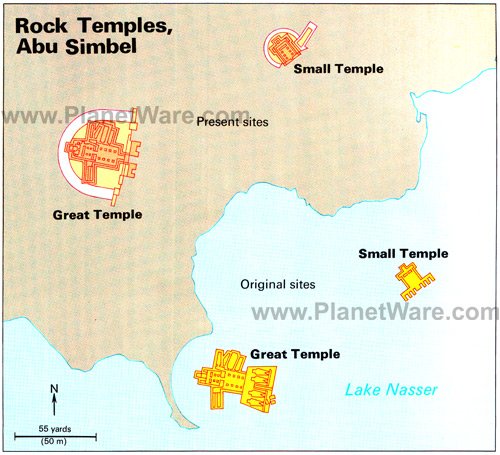 Relocation site of Rock Temples at Abu Simbel Map (Historical)
Source: https://www.planetware.com/nubia/abu-simbel-egy-asw-abusim.htm
0 Response to "Three Principles of Art Found in the Abu Simbel"
Post a Comment